Tailored CRM Solutions: Building Software Around Existing Business Workflows
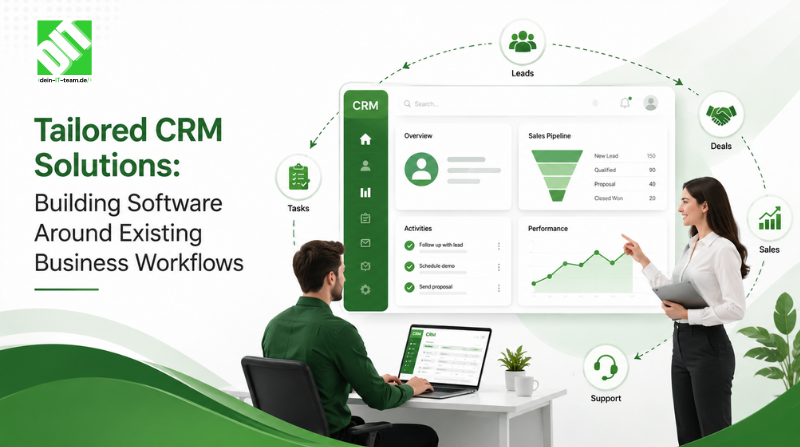
Maximize ROI with custom CRM development. Build software around your existing workflows instead of rigid templates.
Type or paste your content here!When scaling enterprises decide to update their sales tracking or customer management, they often rush to adopt popular, off-the-shelf software platforms. While these rigid platforms promise quick setups, they carry a hidden structural cost: they force your employees to change their daily habits to fit the software’s predetermined fields and unyielding database rules. Instead of technology accelerating your operations, your sales teams, account managers, and administrative squads spend hours executing complex workarounds just to mirror standard, real-world business transactions.
To eliminate this operational friction, technical leaders are prioritizing custom software design over generic SaaS templates. Rather than altering your proven market strategies, your digital tools should be engineered to mirror your exact workflow requirements. Investing in professional custom CRM development services ensures that your technology environment molds directly to your human processes, driving maximum corporate resource efficiency and user adoption.
Key Takeaways
Off-the-shelf CRM software often introduces operational friction by forcing unique business structures into rigid, generic templates.
Custom CRM architectures are engineered from the ground up to support and automate your pre-existing, proven business workflows.
Tailored data schemas prevent data silos, keeping lead tracking and customer communication aligned across departments.
Eliminating unused, bloat features simplifies user interfaces, lowering employee onboarding times and maximizing platform adoption.
Seamless third-party API connectivity ensures a custom CRM centralizes business intelligence without disrupting active tooling layers.
The Strategic Failure of One-Size-Fits-All Customer Platforms
The core issue with generic customer relationship management tools is their reliance on generalized market assumptions. A generic tool treats a B2B engineering firm with a multi-year sales cycle exactly the same as a fast-moving B2C subscription app. To close the gap, businesses end up paying expensive third-party developers to implement complex custom scripts, apps, and extensions on top of the generic software framework.
This layer of extra modification creates severe technical debt and ongoing operational strain. Minor updates from the primary software vendor can break your custom extensions, causing sudden workflow interruptions and unexpected maintenance costs. Over time, your tech stack becomes brittle and difficult to manage. Choosing a clean, tailored custom software development path bypasses these limitations completely, housing your business logic inside a stable, uncompromised repository designed exclusively around your organizational goals.
Mapping Software Design to Human Operational Blueprints
A truly custom CRM does not require your internal teams to rethink how they score leads, handle client escalations, or process invoices. Instead, the software development process begins with a complete audit of your active operational pathways. Engineers map out how a prospective lead enters your sales funnel, how data transfers between account managers, and how reporting metrics reach executive stakeholders.
This structural mapping ensures that the resulting software environment acts as a natural extension of your team's day-to-day habits. It eliminates unnecessary input screens, automates manual data syncs between departments, and displays clear, high-impact business data dashboards relevant to your industry. To scale these heavy data transactions securely without creating system lag or data corruption risks, organizations rely on robust cloud integration services. This guarantees that distributed global teams maintain fast access to unified operational records around the clock.
Maximizing Enterprise ROI by Removing Software Bloat
One of the largest hidden expenses of generic SaaS subscriptions is paying for features your team never uses. Massive enterprise options bundle marketing automation tools, social listening panels, and AI scoring models into premium subscription tiers, even if your business only requires a clear customer tracking engine and polished pipeline reporting. This software bloat clutters the user interface, leading to navigation confusion and dragging down internal employee adoption rates.
Tailored CRM platforms maximize your return on investment by focusing exclusively on functional efficiency. Every database field, interface button, and automated reporting line is built with specific intent, delivering an ultra-clean, accessible workspace. When repetitive manual data tasks like updating contact files across systems are handled automatically by your core software, human error drops significantly. To optimize these background processes even further, integration teams connect platform layers directly with intelligent robotic process automation workflows, allowing automated bots to handle recurring administrative tasks flawlessly.
Furthermore, reading through why CRM data synchronization is critical for seamless customer experience and business growth explains exactly how keeping these custom data records fully aligned across legacy infrastructure prevents costly customer blind spots.
Conclusion
Your software architecture should adapt to your operational habits, not the other way around. Choosing a custom CRM solution built specifically around your active business workflows allows tech leaders to eliminate user experience friction, prevent data silos, and avoid expensive recurring feature licensing costs. By investing in clean, purposeful development, you give your teams a highly reliable digital system that mirrors your exact corporate logic. This optimized setup minimizes administrative overhead and provides a dependable, scalable software foundation ready to power your enterprise’s next stage of market growth.
Frequently Asked Questions
Why should our company invest in a custom CRM instead of a standard SaaS subscription?
Standard SaaS platforms force your business to change its workflows to fit a rigid, template-driven framework, which can lead to complex internal workarounds and low employee adoption. A custom CRM is built completely around your existing processes, meaning it adapts perfectly to your team’s daily habits, cuts out unused feature clutter, and eliminates costly per-user monthly licensing fees.
How does a custom CRM integrate with the software tools we are currently using?
Because a custom CRM features an open, bespoke backend architecture, developers can build direct, clean API integrations connecting it seamlessly to your existing ERP systems, email clients, communication tools, and accounting software. This centralizes your enterprise data pipelines cleanly without requiring you to replace your favorite tools.
Is it difficult for our employees to transition from an old system to a custom CRM?
Actually, the transition is usually much smoother. Because the custom user interface is engineered to reflect the exact stages, terms, and processes your team already knows, the learning curve drops sharply. Employee onboarding timelines are drastically shortened because there are no confusing, irrelevant features to navigate.
Recent Posts
October 23, 2026