

AI Agent Development Cost: What Drives the Budget
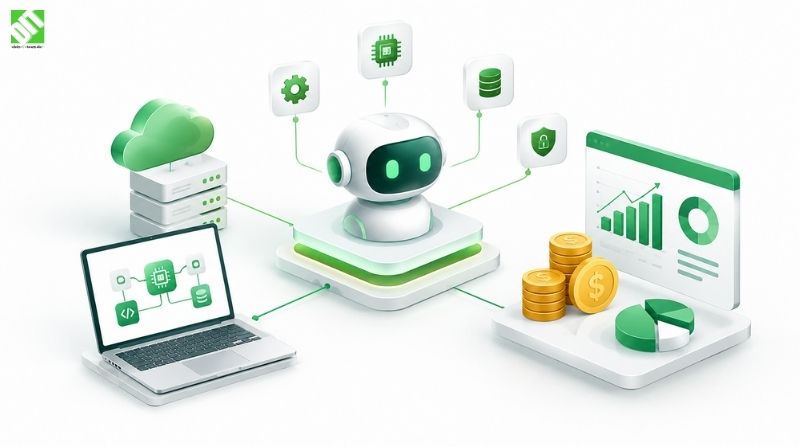
AI agent development cost ranges from EUR 8,000 to 250,000+. See what drives the budget, from scope to integrations, plus a phased MVP path.
Most AI agent projects in Europe land between EUR 8,000 for a narrow, single-task agent and EUR 250,000 or more for a multi-step, enterprise-grade system. That is a wide range, and the gap comes down to four things: how much the agent is expected to do on its own, how many systems it has to connect to, how much safety and testing it needs, and where it runs.
This guide breaks down the AI agent development cost by each of those drivers. It also covers the running costs people tend to forget and a phased MVP path with budget ranges, so you can start small and spend more only when the agent has earned it. The figures here are planning ranges based on typical project structures, not a quote. Your final number depends on your scope, your data, and your existing systems.
What Is an AI Agent, and Why Does It Cost More Than a Chatbot?
An AI agent is software that uses a language model to decide what to do next, then acts on that decision through tools such as APIs, databases, or business applications. A chatbot answers a question. An agent reads an incoming invoice, checks it against a purchase order in your ERP, flags a mismatch, and drafts a message to the supplier.
That ability to take actions is exactly what raises the price. A chatbot needs a good prompt and a knowledge source. An agent needs tool definitions, permission handling, memory, error recovery, logging, and a way to prove it behaves correctly. Each of those is real engineering work. If you are still deciding whether you need an agent at all, our AI agent development services team usually starts with that exact question, because a simpler solution is sometimes the better answer.
How Much Does It Cost to Build an AI Agent?
Here is the short version, so you can orient yourself before the detail.
| Agent type | Typical build budget | Typical timeline |
| Single-task agent (one workflow, one or two tools) | EUR 8,000 to 25,000 | 3 to 6 weeks |
| Multi-step agent (several tools, branching logic, memory) | EUR 25,000 to 80,000 | 2 to 4 months |
| Multi-agent or enterprise system (orchestration, many integrations, strict compliance) | EUR 80,000 to 250,000+ | 4 to 9 months |
These figures cover design, development, integration, and testing for the first production release. They do not include ongoing model usage and hosting, which we cover further down. The same logic applies to any AI development cost estimate: the model itself is rarely the expensive part. Everything around it is.
Cost by Agent Scope: Single Task vs Multi-Step
Scope is the biggest single lever on your budget, so it deserves the most attention.
Single-task agents
A single-task agent does one job well. Examples include classifying and routing support tickets, extracting fields from documents, or summarizing sales calls into CRM notes. The logic is mostly linear: input arrives, the model processes it, a result goes to one destination.
Because the path is predictable, testing is simpler and failure modes are easier to contain. This is why these agents sit at the low end of the range, and why they make an excellent first project.
Multi-step agents
A multi-step agent plans a sequence, calls different tools along the way, and adjusts when something unexpected happens. Think of an agent that handles a refund request: it verifies the order, checks the policy, decides whether the case is routine, issues the refund or escalates to a human, and updates the customer record.
The cost climbs for a few reasons:
The agent needs a reliable way to choose between tools and recover when a tool call fails.
It needs memory so it can carry context across steps and sessions.
The number of possible paths grows quickly, so testing effort grows faster than feature count.
Human-in-the-loop checkpoints have to be designed and built into the workflow.
Multi-agent systems
Some problems are split across several specialized agents coordinated by an orchestrator, for instance one agent for research, one for drafting, and one for compliance checking. This adds coordination logic, shared state, and a much larger evaluation surface. It can be the right design for complex operations, but it should be earned by a working single agent first, not assumed from day one.
How Integrations Change the Price
An agent that cannot reach your systems is just a clever text generator. Integrations are what turn it into something useful, and they are also where budgets quietly expand.
Each integration involves more than a connection. Someone has to handle authentication, rate limits, data mapping, error handling, and permissions so the agent can only do what it is allowed to do. A modern SaaS tool with a clean REST API might take a few days. A legacy ERP with limited documentation can take weeks.
As a rough planning figure, budget EUR 2,000 to 15,000 per integration, depending on API quality and how much data transformation is involved. Three simple integrations are very different from three legacy systems.
| Integration type | Relative effort | Common examples |
| Well-documented SaaS API | Low | CRM, helpdesk, email, calendar |
| Internal database or data warehouse | Medium | Reporting databases, document stores |
| ERP or line-of-business system | Medium to high | Finance, inventory, HR platforms |
| Legacy or undocumented system | High | Older on-premise applications |
Clean, well-designed API development and integration work matters more here than most teams expect. If your internal systems already expose stable APIs, the agent project gets cheaper. If they do not, part of your AI budget will really be an API modernization budget, and it is better to know that before you start.
Guardrails and Evaluation: The Cost Teams Underestimate
This is the line item most often missing from early estimates, and it is the one that separates a demo from something you can trust with real customers or real money.
What guardrails involve
Guardrails are the controls that keep an agent inside safe boundaries. In practice that means:
Input and output filtering for sensitive data and off-topic requests
Permission scoping, so the agent can read an invoice but not approve a payment
Approval steps for high-impact actions
Rate limits and spending caps to stop runaway loops
Audit logs that record what the agent did and why
What evaluation involves
Evaluation answers a simple question: does the agent do the right thing, consistently? Language models are not deterministic, so you cannot test them once and call it done. A proper evaluation setup includes a set of realistic test cases, automated scoring, regression checks every time you change a prompt or a model, and a review process for edge cases found in production.
Building this well typically adds 15 to 25 percent to the core build cost. For agents that touch regulated data, such as finance or health information, or that fall under the EU AI Act, plan toward the higher end. Skipping it saves money in month one and costs much more in month six, usually when an agent makes a confident mistake in front of a customer.
Hosting, Infrastructure, and Running Costs
Building the agent is a one-time investment. Running it is a monthly one, and it should be in your business case from the start.
Model usage
Most agents call a hosted language model and pay per token. Cost depends on how long the prompts are, how many steps each task takes, and how many tasks you run. An agent handling a few hundred tasks a day might cost a few hundred euros a month in usage. A high-volume agent making many model calls per task can reach several thousand. Prompt design, caching, and routing simple steps to smaller models can cut this meaningfully.
Hosting and infrastructure
You also pay for the environment the agent runs in: compute, a database or vector store for memory and knowledge, queues for background work, monitoring, and secure networking. A typical production setup runs from roughly EUR 300 to 3,000 per month depending on load and redundancy.
For European businesses, data residency often shapes this decision. Keeping data in an EU region and choosing between a public cloud, a private deployment, or a self-hosted model changes both the architecture and the price. Self-hosting a model can lower per-request cost at scale but adds infrastructure and maintenance work, so it rarely makes sense for a first release.
Maintenance
Models change, APIs change, and business rules change. Plan for roughly 15 to 20 percent of the initial build cost per year for monitoring, prompt tuning, model upgrades, and bug fixes. Agents that are not maintained tend to degrade quietly.
Other Factors That Move the Budget
A few smaller variables are worth naming, because they can shift an estimate by tens of percent:
Data readiness. If your knowledge is scattered across PDFs, emails, and old wikis, expect cleanup and structuring work before the agent can use it well.
User interface. An agent that lives inside Slack or Teams is cheaper than one with a custom web interface. Good UX design can still be worth it when non-technical staff will use the agent daily, but that is a deliberate choice, not a default.
Compliance requirements. GDPR, sector regulation, and the EU AI Act add documentation, review, and sometimes architectural constraints.
Team composition. Senior AI engineers, solution architects, and QA specialists cost more per hour than generalists, but they usually reduce total cost by avoiding rework.
How an Agent Project Compares to Custom Software
An AI agent project is a software project with an unusual component at its center. Most of the usual cost logic still applies: discovery, architecture, integration, testing, deployment, and support. If you want a grounded view of how those standard costs behave in the German market, our breakdown of custom software development cost in Germany is a useful companion to this article.
The difference is the uncertainty. In traditional software, the same input always produces the same output, so effort is easy to predict. With agents, you have to budget for experimentation and tuning, which is a good reason to phase the work instead of committing to one large fixed scope.
A Phased MVP Path With Budget Ranges
Phasing is the most reliable way to control the AI agent development cost. Each phase has a clear goal and a clear decision point, so you can stop, adjust, or continue based on evidence.
Phase 0: Discovery and feasibility (2 to 3 weeks, EUR 3,000 to 8,000)
The goal is to confirm that the use case is worth automating and technically feasible. This phase covers process mapping, data and system review, risk assessment, success metrics, and a rough architecture. You come away with a scoped plan and a much firmer estimate.
Phase 1: Focused MVP (6 to 10 weeks, EUR 15,000 to 40,000)
Build one agent for one workflow with one to three integrations and a basic evaluation set. A human reviews outputs where the stakes are higher. The point is to prove the agent can do real work, not to cover every scenario.
Phase 2: Pilot and hardening (6 to 12 weeks, EUR 15,000 to 45,000)
Release to a limited group of real users. Expand the evaluation suite using real cases, tighten guardrails, add monitoring dashboards, and fix the failure patterns that only appear with live traffic. This is where most of the reliability is built.
Phase 3: Scale and extend (ongoing, EUR 30,000 to 100,000+)
Add more workflows, more integrations, and possibly additional agents. Introduce cost optimization, stronger governance, and deeper integration with your core systems. Only proceed here if the earlier phases show measurable results.
| Phase | Duration | Budget range | Decision it supports |
| Discovery | 2 to 3 weeks | EUR 3,000 to 8,000 | Is this worth building? |
| Focused MVP | 6 to 10 weeks | EUR 15,000 to 40,000 | Does the agent do real work? |
| Pilot and hardening | 6 to 12 weeks | EUR 15,000 to 45,000 | Is it reliable enough to roll out? |
| Scale and extend | Ongoing | EUR 30,000 to 100,000+ | Where does it grow next? |
A realistic first-year total for a business that follows this path often falls between EUR 40,000 and 120,000 including early running costs, which is far less risky than committing EUR 150,000 to a full build before anyone has seen the agent work.
A Practical Example
Imagine a mid-sized logistics company that wants an agent to handle delivery exception emails. This is an illustrative scenario, not a client project.
In Phase 0, the team maps how dispatchers currently handle late deliveries and finds that around 60 percent of cases follow a few repeatable patterns. In Phase 1, a single agent reads incoming emails, looks up the shipment in the transport management system, and drafts a reply for a dispatcher to approve. That requires two integrations and a small evaluation set built from past emails. In Phase 2, the agent is released to one regional team, and the cases it handles badly become new test cases. Only after that does the company consider letting the agent send routine replies automatically.
Notice that the budget grows only as confidence grows. That is the pattern to look for in any agent roadmap.
Ways to Reduce AI Agent Development Cost Without Cutting Corners
Start with one narrow, high-volume workflow instead of a general assistant.
Keep a human approval step on high-impact actions until the data supports removing it.
Reuse your existing APIs and data sources rather than building new ones.
Use smaller, cheaper models for simple steps and reserve larger models for reasoning-heavy ones.
Invest in evaluation early; it prevents expensive rework later.
Define success metrics before development, such as handling time, accuracy, or deflection rate, so you can judge the return honestly.
Choosing the Right Development Partner
Ask any prospective partner how they test agent behavior, how they handle failures and permissions, how they would phase the work, and what the running costs will be after launch. A vague answer to any of these is a warning sign. A good partner will talk about evaluation and guardrails as readily as they talk about features, and will be comfortable recommending a smaller first step.
Conclusion
AI agent development cost is driven less by the AI model and more by the engineering around it: how much autonomy the agent has, how many systems it touches, how rigorously it is tested and constrained, and how it is hosted and maintained. Expect roughly EUR 8,000 to 25,000 for a focused single-task agent, EUR 25,000 to 80,000 for a multi-step agent, and more for enterprise systems, plus ongoing usage, hosting, and maintenance.
The safest path is phased. Validate the use case, build a focused MVP, harden it with real users, and scale only when the numbers justify it. If your agent will run in the cloud and connect to several business systems, it is worth planning cloud integration and deployment early, since hosting and data residency decisions affect both cost and compliance.
If you are weighing an agent project and want a clearer estimate for your own situation, you can discuss your project with the DEIN IT TEAM and start with a short discovery conversation.
Frequently Asked Questions
How much does it cost to build an AI agent?
A focused single-task agent usually costs EUR 8,000 to 25,000. A multi-step agent with several tools typically runs EUR 25,000 to 80,000, and enterprise or multi-agent systems can exceed EUR 250,000. The final figure depends on scope, integrations, and testing requirements.
How long does AI agent development take?
Simple agents can be built in 3 to 6 weeks. Multi-step agents usually take 2 to 4 months, and complex enterprise systems 4 to 9 months. A phased approach delivers a working MVP in roughly 8 to 13 weeks including discovery.
What are the ongoing costs after launch?
Expect monthly model usage fees, hosting and infrastructure costs, and annual maintenance of about 15 to 20 percent of the build cost. Usage varies widely with task volume and how many model calls each task requires.
Why do integrations affect the AI development cost so much?
Each integration needs authentication, data mapping, error handling, and permission control. Modern SaaS APIs are quick to connect, while legacy or poorly documented systems can take weeks, so the number and quality of your systems strongly influence the budget.
Do I need guardrails and evaluation for a simple agent?
Yes, though the effort scales with risk. Even a simple agent benefits from logging, permission limits, and a test set. Agents that handle customer communication, payments, or sensitive data need much more thorough controls.
Should I build a custom agent or use an off-the-shelf tool?
Off-the-shelf tools work well for common, low-risk tasks such as basic support automation. A custom agent makes sense when you need deep integration with internal systems, specific business rules, strict data control, or a competitive workflow you do not want to share with a generic platform.
Can an AI agent integrate with my existing ERP or CRM?
Usually yes, provided the system offers an API or another reliable access method. The effort depends on the quality of that access. Older systems may need an intermediate API layer before an agent can use them safely.
Is it better to self-host the model or use a hosted model?
For most first releases, hosted models are cheaper and faster to start with. Self-hosting can make sense later for data residency, regulatory, or high-volume cost reasons, but it adds infrastructure and maintenance work.
Recent Posts
October 23, 2026
October 12, 2026