ERP Development Company: How to Evaluate One and What It Costs
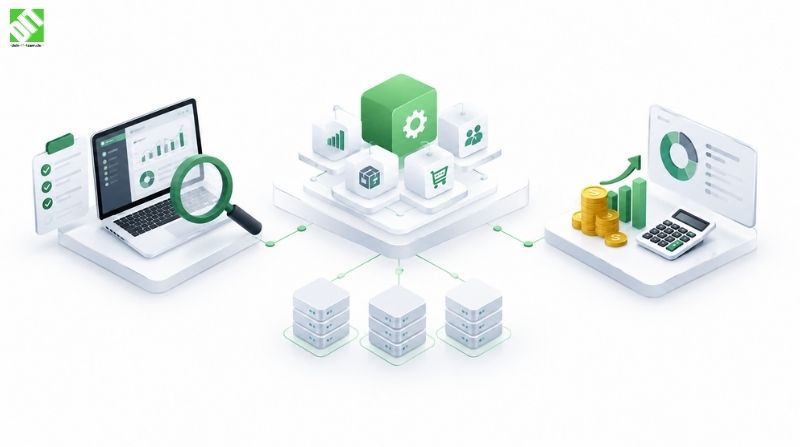
Choosing an ERP development company? Use this evaluation checklist and see realistic cost ranges and timelines by ERP module before you commit.
An ERP development company designs, builds, integrates and supports enterprise resource planning software that fits the way your business actually runs. The right one will ask hard questions about your processes before it quotes a price. The wrong one will hand you a feature list and a deadline.
Most of the regret in ERP projects traces back to the selection stage. Teams compare day rates, skim a portfolio, and sign. Months later they discover the vendor never worked with their kind of inventory logic, cannot connect to the accounting system that is staying in place, or staffed the project with a rotating cast of junior developers.
This guide gives you a practical way to evaluate a vendor, then shows what custom ERP development typically costs and how long each module takes. The figures are planning ranges, not quotes, and we explain what moves them up or down.
What an ERP Development Company Actually Does
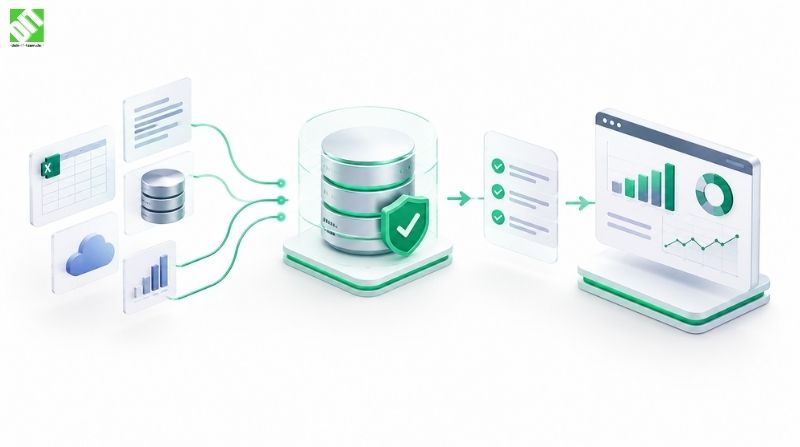
An ERP system is a single platform that connects core business functions such as finance, inventory, procurement, sales, HR and operations around one shared database. When finance posts an invoice, inventory, sales and reporting all see the same record.
An ERP development company covers the work needed to get that platform running for your business. Depending on the engagement, that includes:
Discovery and process mapping
Custom ERP development or deep configuration of an existing platform
Data migration from spreadsheets and legacy tools
Integration with the systems that stay in place
Testing, rollout and user training
Maintenance, support and ongoing improvement
It helps to separate three types of providers, because they behave very differently:
| Provider type | What they sell | Typical fit |
| Software reseller or implementer | Licences and configuration of a packaged ERP | Standard processes, faster start |
| Custom ERP development company | Software built around your workflows | Unusual processes, industry-specific rules |
| Hybrid partner | Packaged core plus custom modules and integrations | Mixed needs, phased rollouts |
If you are weighing a bespoke build against a licensed product, the question is rarely about technology. It is about how much of your competitive advantage lives in your processes. If a lot does, forcing those processes into a generic template tends to cost more over five years than building around them. For organisations in that position, custom software development is usually the starting point, with ERP modules built as part of a wider architecture.
How to Evaluate an ERP Development Company
A good evaluation tests five things: scope fit, module experience, integration skill, team model and pricing clarity. Use the checklist below as a scoring sheet. Rate each vendor from one to five on every point and ask for evidence, not reassurance.
1. ERP Scope and Process Understanding
Start with how the vendor handles your scope, because it predicts everything that follows.
Do they run a paid or structured discovery phase before fixing a price?
Do they ask about exceptions, approval chains, edge cases and reporting needs, or only about screens and features?
Can they explain the difference between what your business needs on day one and what can wait for phase two?
Will they push back when a requested feature adds cost without adding value?
A vendor who agrees with everything you say in the first meeting is not listening closely enough. The best sales conversations include a few uncomfortable questions about how your teams really work.
Visibility is often the underlying driver behind an ERP project. If that is your main goal, our article on how ERP systems improve business visibility and control explains what to expect from reporting and decision-making once the system is live, which helps you define success criteria before you talk to vendors.
2. Module and Industry Experience
ERP is not one product. A team that has built excellent warehouse logic may have never touched multi-entity financial consolidation. Ask for specifics.
Which modules have they built before: finance, inventory, procurement, HR, sales, production planning, reporting?
Have they worked in your industry, or at least with similar process shapes (batch production, project-based billing, multi-warehouse distribution)?
Can they walk you through a past project's structure, challenges and outcomes, without needing to name the client?
Be careful with generic claims such as "we build all types of ERP". Ask what was hardest about the last module like yours and listen for concrete answers: reconciliation rules, unit-of-measure conversions, tax handling, role-based approvals. Real experience produces specific stories.
3. Integration With Your Existing Systems
Very few companies replace everything at once. Your ERP will need to exchange data with an existing CRM, ecommerce platform, payroll provider, banking interface, shipping tools or industry-specific machinery. Integration is where timelines slip and budgets stretch, so test it early.
Ask the vendor:
How do they approach data exchange: REST APIs, message queues, scheduled file transfers, webhooks?
How do they handle failures, retries and duplicate records between systems?
Who documents the integration, and who owns it after launch?
What is their plan for migrating historical data, and how do they validate it?
A strong partner treats integration as a design discipline, not a late-stage task. That means a clear API layer, versioned contracts and monitoring. Specialist API development and integration capability matters here, because a poorly designed interface between ERP and the rest of your stack creates data problems that surface months after go-live.
4. Team Model and Delivery Approach
Who will actually build your system? This is often the least discussed and most important point.
Is there a named project manager and a named technical lead?
What is the mix of senior and junior engineers on your project?
Do you work with an agile process with regular demos, or do you wait months to see anything?
How is time-zone overlap handled, and what response times can you expect?
What happens if a key team member leaves mid-project?
Also ask about engagement models. Fixed price suits tightly defined modules. Time and materials suits evolving scope. A dedicated team suits long programmes where the ERP keeps growing. A vendor with only one model will push every project into it, whether it fits or not.
5. Pricing, Contract and Ownership
Pricing transparency tells you how the vendor will behave when something changes.
Is the estimate broken down by module, integration and phase, or is it a single number?
What is excluded: data migration, training, third-party licences, hosting, post-launch support?
How are change requests priced and approved?
Do you own the source code, documentation and infrastructure configuration?
What does the support agreement cover and what does it cost per year?
Ask for the assumptions behind every estimate. A price without assumptions is a guess, and a guess is the first thing to change.
Red Flags Worth Walking Away From
A fixed price quoted before any discovery work
No questions about your integrations or data quality
Reluctance to discuss who will be on the team
Vague answers on code ownership
No testing or security approach explained
A portfolio with no depth, only screenshots
How Much Does Custom ERP Development Cost?
Custom ERP development usually costs between roughly €40,000 for a focused first release and €500,000 or more for a broad, multi-module system. That spread is wide because "ERP" can mean three modules for one department or a platform for a multi-site group.
These are indicative planning ranges for custom builds. Your actual price depends on the factors listed after the table, and any vendor should confirm it after discovery.
Cost Ranges and Timelines by Module
| Module | Typical cost range | Typical timeline | What drives the range |
| Finance and accounting | €15,000 to €50,000 | 6 to 12 weeks | Multi-currency, tax rules, consolidation, audit trails |
| Inventory and warehouse | €15,000 to €45,000 | 6 to 10 weeks | Number of locations, batch or serial tracking, barcode use |
| Procurement and purchasing | €12,000 to €40,000 | 5 to 9 weeks | Approval workflows, supplier portals, three-way matching |
| Sales and order management | €10,000 to €35,000 | 5 to 8 weeks | Pricing rules, quotes, ecommerce connections |
| HR and payroll support | €12,000 to €40,000 | 5 to 10 weeks | Local labour rules, leave logic, payroll provider links |
| Production and manufacturing | €30,000 to €90,000 | 10 to 20 weeks | Bills of materials, scheduling, shop-floor data |
| Reporting and business intelligence | €8,000 to €30,000 | 3 to 8 weeks | Number of dashboards, data sources, real-time needs |
| Integration per external system | €5,000 to €25,000 | 2 to 6 weeks | API quality, data volume, legacy interfaces |
Modules are not simply added together. A shared data model, user management and security layer are built once and reused, which is why a full system is often cheaper per module than building each one in isolation. At the same time, the foundation itself carries a cost that appears in the first release.
Typical Total Budgets by Project Size
| Project size | Scope | Indicative budget | Typical timeline |
| Focused first release | 2 to 3 modules, 1 to 2 integrations | €40,000 to €100,000 | 3 to 5 months |
| Mid-sized ERP | 4 to 6 modules, several integrations, migration | €100,000 to €250,000 | 6 to 10 months |
| Broad enterprise ERP | Multi-entity, multi-site, advanced workflows | €250,000 to €500,000+ | 10 to 18 months |
What Moves the Cost Up or Down
Process complexity. Ten approval rules cost more than two. Exceptions are expensive; standard flows are cheap.
Number of users and roles. Permissions, audit logs and role-based views add design and testing effort.
Integrations. Each connected system brings mapping, error handling and testing. Poorly documented legacy systems cost the most.
Data migration. Clean data moves quickly. Duplicate customers, inconsistent product codes and missing history do not.
Real-time features. Live inventory, instant dashboards and event-driven updates need more architecture than nightly batches.
Security and compliance. Access control, encryption, logging and regional data requirements all need to be built in from the start.
Hosting and infrastructure. Cloud setup, environments, backups and monitoring are ongoing costs, not just launch costs.
Team composition. A senior-heavy team costs more per hour but often finishes sooner and with fewer defects.
Post-launch support. Plan roughly 15 to 20 percent of the build cost per year for maintenance, fixes and small enhancements as a common starting assumption.
Custom ERP vs Off-the-Shelf: A Fair Comparison
| Factor | Off-the-shelf ERP | Custom ERP |
| Upfront cost | Lower | Higher |
| Licence fees | Recurring, per user | Usually none, or fewer |
| Fit to your processes | Adapt your process to the tool | Tool adapts to your process |
| Time to first use | Faster | Slower |
| Flexibility over time | Limited by vendor roadmap | You control the roadmap |
| Long-term cost | Grows with users | Grows with scope |
Neither is always better. Standard processes with common requirements often suit packaged software. Distinctive workflows, strict industry rules or heavy integration needs often favour a custom or hybrid approach.
The ERP Development Process, Step by Step
A reliable vendor follows a visible sequence. The names vary, but the substance should look like this:
Discovery and requirements. Interviews, process mapping, user roles, reporting needs and a clear definition of what phase one includes.
Business and technical analysis. Review of existing systems, data quality, integration points and constraints.
Architecture planning. Data model, module boundaries, API strategy, hosting approach and security design.
UX and interface design. Workflows for the people who will use the system daily. Good UI and UX design is not decoration in ERP; it is the difference between adoption and workarounds in spreadsheets.
Iterative development. Short cycles with working demos, so you can correct course early.
Integration and data migration. Connect external systems, migrate and validate historical data.
Testing and quality assurance. Functional, performance, security and user acceptance testing.
Deployment and training. Staged rollout where possible, with documentation and hands-on training.
Monitoring and maintenance. Performance tracking, bug fixing, updates and continued improvement.
Ask any vendor where in this sequence they usually find the biggest surprises. The honest answer is almost always data migration or integration.
Technology Choices to Discuss With Your Vendor
You should not need to choose the stack yourself, but you should understand the categories and why each choice is made. A responsible vendor will explain trade-offs around:
Frontend framework for the user interface
Backend technology and application architecture (modular monolith or microservices)
Database type and structure for transactional and reporting workloads
Cloud infrastructure and deployment approach
API layer and integration patterns
Authentication, authorisation and audit logging
Reporting and analytics tooling
Monitoring and backup strategy
The final selection depends on your scalability needs, budget, existing infrastructure, security requirements and the skills of the team that will maintain the system. If your organisation already runs on Microsoft or cloud platforms, say so early, because it shapes hosting, identity and reporting decisions.
Security, Compliance and Scalability
ERP systems hold financial records, employee data, supplier terms and customer information in one place, which makes them a high-value target. Ask how the vendor handles:
Role-based access control with least-privilege defaults
Encryption of data at rest and in transit
Audit trails for sensitive changes
Backup, recovery and disaster planning
Regional data protection requirements relevant to your markets
Security testing before each release
Scalability deserves the same attention. A system that works for 20 users and 5,000 orders a month may struggle at 200 users and 100,000 orders. Ask what load the architecture is designed for and how it grows.
A Practical Example
Consider a mid-sized distributor with two warehouses, an existing accounting package they intend to keep, and a web shop. Their pain points are stock counts that never match, manual order entry and reports that take two days to assemble.
An illustrative first phase (not a client project) might include an inventory module with multi-warehouse tracking, an order management module connected to the web shop, a reporting layer pulling from both, and an integration with the existing accounting software. Four to five months and a budget in the lower half of the mid-sized range would be a realistic planning assumption. Purchasing and finance extensions would follow in a second phase once the data foundation is stable.
The point of the example is the sequence. Fix the data and the core workflow first, connect what must stay, and extend later.
Questions to Ask Before You Sign
Bring this short list to your final vendor meetings:
Which three modules in this scope are you most confident about, and why?
What are the top risks in my project, and how will you reduce them?
Who will be on the team, and for how long?
What do you need from my staff each week?
How will we measure progress before launch?
What does the first year after go-live look like, and what does it cost?
If we part ways, what do I walk away with?
Choosing the Right ERP Development Partner
Selecting an ERP development company comes down to evidence. Look for a team that tests your assumptions, shows real module experience, treats integration as a first-class concern, is open about who builds your system, and prices with clear assumptions. Budget for the full lifecycle, not only the build, and start with a phase that delivers working value early.
If your next step is defining scope and getting a realistic estimate, you can explore our ERP software development services and discuss your project with the DEIN IT TEAM. A short discovery conversation is usually enough to tell you which modules to build first and what a sensible budget looks like.
Frequently Asked Questions
What does an ERP development company do?
It plans, builds, integrates and supports enterprise resource planning software. That covers process analysis, custom module development, data migration, integration with existing tools, testing, rollout, training and ongoing maintenance.
How much does custom ERP development cost?
Most projects fall between about €40,000 for a focused first release and €500,000 or more for a large multi-module system. The main drivers are process complexity, number of modules, integrations, data migration and security needs. A discovery phase is the reliable way to get a firm figure.
How long does it take to build a custom ERP system?
A focused release with two or three modules typically takes three to five months. A mid-sized system often takes six to ten months, and broad enterprise programmes can run ten to eighteen months. Phased delivery lets you start using finished modules while others are still in development.
Should I build a custom ERP or buy an off-the-shelf one?
Off-the-shelf software suits standard processes and faster starts. Custom development suits distinctive workflows, strict industry requirements and heavy integration needs. Many companies choose a hybrid: a packaged core with custom modules where their processes are unique.
Can a new ERP integrate with my existing systems?
Yes, if the integration is planned properly. Typical connections include accounting software, CRM, ecommerce platforms, payroll, banking and logistics tools. Ask the vendor how they handle error recovery, data validation and documentation for every integration.
What should I look for in an ERP development partner?
Look for structured discovery, experience with the specific modules you need, proven integration practice, a transparent team model, clear pricing assumptions and clear code ownership. Specific answers about past challenges are a better signal than a long client list.
How much should I budget for ERP maintenance?
A common planning assumption is 15 to 20 percent of the initial build cost per year. This covers fixes, updates, hosting, monitoring and small enhancements. Your actual figure depends on system size, release frequency and support level.
Is a custom ERP secure and scalable?
It can be, when security and scalability are designed in from the start. That means role-based access, encryption, audit trails, regular testing and an architecture sized for future user and data growth. Ask the vendor to explain how each is handled rather than accepting a general assurance.
What are the first steps to start an ERP project?
Document your current processes, list your pain points, identify the systems that must stay, and define what phase one must achieve. Then shortlist two or three vendors and compare them using a consistent checklist.
Recent Posts
September 30, 2026
September 28, 2026