

Data Quality Management: Best Practices for Accurate Business Data
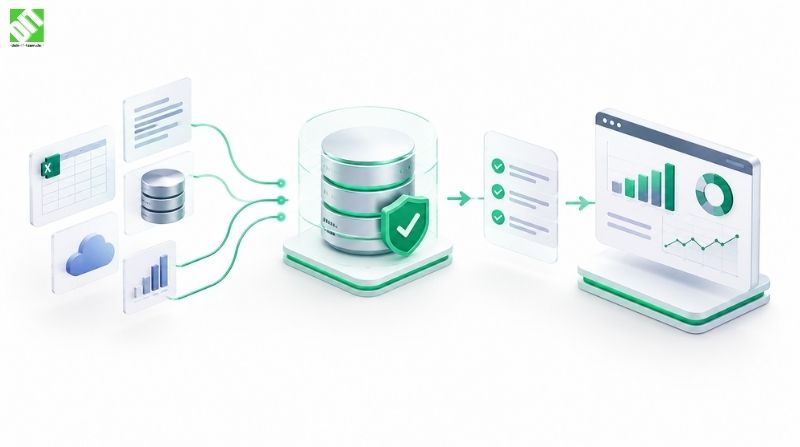
Learn data quality management best practices to keep business data accurate, consistent and trustworthy, from profiling and governance to automation.
Most companies don't notice a data problem until it costs them something. A sales report that doesn't match finance. A customer who gets the same email three times. An inventory count that says 40 units when the shelf is empty. Each of these looks like a small glitch, but together they erode trust in every dashboard and every decision built on top of the data.
Data quality management is the discipline that prevents this. It is the set of practices, roles, rules and tools a business uses to keep its data accurate, complete, consistent and usable. This article explains what data quality management involves, where bad data comes from, which best practices work in real organizations, and how to build a process that lasts beyond a one-time cleanup.
What Is Data Quality Management?
Data quality management (DQM) is the ongoing process of defining, measuring, monitoring and improving the quality of an organization's data so it is fit for its intended use.
Two parts of that definition matter. First, "ongoing": data quality is not a project you finish. Data decays, systems change and people enter information in different ways. Second, "fit for its intended use": the same dataset can be good enough for a monthly trend report and completely unusable for billing. Quality is always judged against a purpose.
DQM usually covers these activities:
Defining quality standards and business rules for key data
Profiling data to understand its current condition
Validating data when it is created or imported
Cleansing and standardizing existing records
Monitoring quality over time with measurable indicators
Assigning ownership and accountability
Fixing the root causes of recurring errors
It overlaps with data governance, but the two are not identical. Governance sets the policies, roles and decision rights around data. Data quality management is how those policies turn into measurable, day-to-day results.
Why Data Quality Management Matters for Business
Bad data rarely announces itself. It shows up as extra work, slower decisions and quiet mistrust.
Decisions get weaker. Forecasts, pricing models and capacity plans all assume the inputs are right. If duplicate customer records inflate your customer count, every per-customer metric is off.
Operations slow down. Teams spend hours reconciling spreadsheets, correcting addresses and chasing missing fields. Much of this work is invisible because it is absorbed into normal workloads.
Customer experience suffers. Wrong names, outdated contact details and mismatched order histories are visible to customers, and they remember them.
Compliance risk increases. Regulations such as GDPR place obligations on accuracy and on knowing where personal data lives. If you can't find or correct a person's record reliably, you can't meet a deletion or correction request reliably either.
AI and analytics projects underperform. Machine learning models learn from whatever they are given. Poor training data produces unreliable predictions, and the problem is often blamed on the model instead of the data.
The Core Dimensions of Data Quality
You can't improve what you can't describe. Data quality is usually broken into dimensions, each of which can be measured separately.
| Dimension | What it means | Example of a failure |
| Accuracy | Data correctly reflects the real-world fact | A customer's phone number has a wrong digit |
| Completeness | Required values are present | Orders with no delivery address |
| Consistency | The same fact matches across systems | Customer status is "active" in CRM and "closed" in billing |
| Timeliness | Data is current enough for its use | Stock levels updated once a day for a live web shop |
| Validity | Data follows the required format and rules | A date entered as 31/02/2026 |
| Uniqueness | Each entity appears once | The same supplier stored under three spellings |
| Integrity | Relationships between records hold | An invoice linked to a customer ID that no longer exists |
Not every dimension matters equally for every dataset. For a payments table, accuracy and integrity are critical. For marketing analytics, completeness and uniqueness may cause more day-to-day pain. Part of good DQM is deciding which dimensions matter most for each data domain.
Where Poor Data Quality Comes From
Before choosing tools or writing rules, it helps to know how bad data gets into your systems. Cleaning records without understanding the source means you'll be cleaning them again next quarter.
Manual data entry. Typos, skipped fields and inconsistent formats are the classic cause. Free-text fields are especially risky because "Munich", "München" and "Muenchen" are all valid to a human and three different values to a database.
Disconnected systems. When the CRM, ERP, e-commerce platform and finance tools each keep their own version of a customer or product, they drift apart. Every manual export and re-import is another chance for errors to enter.
Weak integrations. Point-to-point connections built in a hurry often skip validation, transformation rules and error handling. A well-designed API development and integration layer can enforce formats, reject malformed payloads and keep systems synchronized from a single, controlled path instead of a tangle of one-off scripts.
Mergers, migrations and legacy systems. Combining datasets from different sources with different structures almost always creates duplicates and mapping errors. Legacy systems may also store data in formats no modern tool expects.
Missing ownership. If nobody is responsible for a dataset, nobody fixes it. Errors get worked around instead of resolved.
Natural decay. People change jobs, move, change names and close companies. Even perfectly entered data goes stale if it is not refreshed.
Data Quality Management Best Practices
These practices are ordered roughly the way most organizations should adopt them. You don't need to implement all of them at once.
1. Assign Clear Ownership
Every important data domain (customers, products, suppliers, finance) needs a named business owner. This is usually someone from the business side, not IT. The owner decides what "good" means, approves the rules and is the person to call when quality drops.
Many teams also name data stewards, people who handle the day-to-day work of resolving issues. IT supports with tooling and infrastructure, but the business owns the meaning of the data.
2. Define Quality Standards Tied to Business Outcomes
"We need cleaner data" is not a standard. A standard is specific: "Every active customer record must have a valid email, a country code and a unique customer ID." Write rules in plain language first, then translate them into technical checks.
A useful test: if a rule can't be linked to a real business consequence, such as failed deliveries, billing disputes or compliance exposure, it probably isn't a priority.
3. Profile Your Data Before Fixing It
Data profiling means analyzing datasets to see what is actually in them: value distributions, null rates, duplicate counts, format patterns and outliers. It usually surprises people. Fields assumed to be 99% complete turn out to be 70% complete, or a "mandatory" field is full of placeholder values like "N/A" and "xxx".
Profiling gives you a baseline. Without one, you can't prove that anything improved.
4. Validate at the Point of Entry
Prevention is cheaper than correction. Catching an invalid value when it is typed or imported costs almost nothing; finding it six months later in a report costs a lot more.
Effective entry-level controls include:
Dropdowns and controlled vocabularies instead of free text
Format and range checks (postal codes, dates, VAT numbers)
Required-field enforcement
Duplicate detection when a new record is created
Validation in APIs and import jobs, not only in user interfaces
That last point is often missed. A form may be well validated while a nightly import job writes straight to the database with no checks at all.
5. Standardize and Cleanse Existing Data
Once you know the state of your data, clean it systematically. Common cleansing tasks include:
Standardizing formats (dates, phone numbers, addresses, units)
Removing or merging duplicates
Correcting known errors against trusted reference data
Filling gaps where reliable sources exist
Archiving or deleting records that are obsolete
Keep an audit trail of what changed and why. Automated cleansing is powerful, but merging records incorrectly can destroy useful information, so high-risk merges should have human review.
6. Establish a Single Source of Truth for Master Data
Master data is the core reference information a business depends on: customers, products, suppliers, locations, employees. Master data management (MDM) means deciding which system is authoritative for each entity and making sure other systems consume that version instead of keeping their own.
You don't need an enterprise-scale MDM platform to start. Even a clear rule such as "customer details are created and edited only in the CRM and synchronized outward" removes a large source of inconsistency.
7. Monitor Quality Continuously
A one-time cleanup decays within months. Set up automated checks that run on a schedule or on every data load, and surface the results in a dashboard people actually look at. Alerts should go to the data owner, not into a shared inbox where they get ignored.
8. Fix Root Causes, Not Just Symptoms
When an error appears, ask where it entered the system. If the same issue keeps returning, the fix belongs upstream: a validation rule, a changed form, a corrected integration mapping, or a training gap. A simple practice that works: log every recurring data issue with its root cause and track how many are permanently resolved versus repeatedly cleaned.
9. Train the People Who Touch the Data
Employees who enter data need to understand why the rules exist. Showing a sales team how a missing field leads to a failed invoice is far more effective than a policy document. Keep training short, specific and tied to the systems people really use.
How to Build a Data Quality Management Process
If you are starting from zero, this sequence works for most organizations:
Pick a high-value starting point. Choose one data domain tied to a clear business problem, such as customer data feeding invoicing. Don't try to fix everything.
Identify critical data elements. List the fields that, if wrong, cause real damage.
Profile the current state. Measure completeness, duplicates, validity and consistency to set a baseline.
Define rules and thresholds. Agree with the business what acceptable quality looks like, for example "duplicate rate below 1%".
Implement prevention controls. Add validation at entry points, imports and integrations.
Cleanse existing data. Prioritize records that are actively used.
Monitor and report. Track the agreed metrics and review them regularly with the data owner.
Investigate and resolve root causes. Feed what you learn back into rules, systems and training.
Expand to the next domain. Reuse the playbook, roles and tooling.
Teams that follow this tend to show visible improvement in one domain within weeks, which builds the internal support needed to continue.
Data Quality and Integration Architecture
A large share of data quality problems are really integration problems. When data moves between systems in batches, with little validation and long delays, discrepancies pile up between runs. Two teams look at the same customer at the same moment and see different facts.
Moving toward event-driven or near real-time synchronization narrows that gap, and it forces you to define clear data contracts between systems: which fields are required, what formats are accepted, and what happens when a message fails validation. The reasoning behind this is covered in more depth in this article on why businesses need real-time data integration.
A few architectural principles help regardless of the specific technology:
Validate at boundaries. Check data whenever it crosses from one system to another, not only when humans enter it.
Use schemas and contracts. Explicit definitions of structure and required values make breaking changes visible early.
Handle failures visibly. Rejected records should land in a review queue with a reason, not disappear silently.
Keep lineage. Know where each piece of data came from and what transformed it, so errors can be traced back.
Prefer one write path per entity. If five systems can edit the same customer record, conflicts are guaranteed.
Automating Data Quality Management
Manual checks don't scale. Automation makes quality rules run consistently, on every record, without depending on someone remembering to do it.
Rule-based validation and cleansing. Format checks, duplicate matching, reference-data lookups and standardization rules can run automatically during ingestion or on a schedule.
Workflow and process automation. Plenty of bad data originates in repetitive manual work, such as copying values from emails, PDFs or legacy screens into another system. Robotic process automation can take over this kind of repetitive, rules-based transfer, applying the same validation steps every time and flagging exceptions for a person instead of letting errors pass through.
Machine learning for anomalies. Statistical and machine learning methods can detect values that look unusual compared with historical patterns: a sudden spike in null values, an order amount far outside the normal range, or a supplier name that is probably a variant of an existing one. These methods complement fixed rules; they are good at catching problems you didn't think to write a rule for.
Automation should have guardrails. Automatic corrections need logging, thresholds for when a human reviews the change, and a way to roll back.
Measuring Data Quality: Metrics That Matter
Pick a small set of metrics that tie to business outcomes. Common ones include:
| Metric | How it is typically calculated |
| Completeness rate | Records with all required fields filled / total records |
| Duplicate rate | Duplicate records / total records |
| Validity rate | Records passing format and rule checks / total records |
| Consistency rate | Matching values across systems / total compared records |
| Timeliness | Average age of data or delay between a real-world change and its update |
| Issue resolution time | Time from detection to confirmed fix |
| Downstream impact | Failed deliveries, rejected invoices or returned mail caused by data errors |
Technical scores alone can be misleading. A 98% completeness rate sounds excellent until you learn the missing 2% are your highest-value accounts. Always pair the percentages with a business impact measure, so executives see why the number matters.
Choosing Data Quality Tools and Technology
Rather than starting with a product name, start with the capabilities you need. Typical categories include:
Data profiling tools for assessing current condition
Data cleansing and matching tools for standardization and deduplication
Data validation frameworks that run rule checks inside pipelines
Master data management platforms for authoritative entity records
Data catalog and lineage tools for discovery and traceability
Monitoring and observability tools for detecting anomalies and pipeline failures
Whether to buy a platform, extend what you already run, or build custom components depends on several factors: how many systems you integrate, the complexity of your matching rules, regulatory requirements, existing cloud and database infrastructure, internal skills and budget. Organizations with unusual data models or deep ties to ERP and CRM systems often find that a mix works best, with off-the-shelf tooling for generic tasks and custom logic where their business rules are specific.
Common Data Quality Management Mistakes
Treating it as an IT project. If the business doesn't own the rules, IT ends up guessing what "correct" means.
Cleaning without prevention. Scrubbing the database while leaving the entry points unchanged guarantees the same mess returns.
Trying to fix everything at once. Broad programs stall. Narrow, visible wins keep momentum.
Ignoring unstructured and external data. Documents, emails and third-party feeds carry quality risks too, and they're easy to overlook.
Over-relying on tools. Software enforces rules; it can't decide what the rules should be.
No feedback loop. If data consumers can't easily report errors, problems stay hidden until they cause damage.
A Practical Example
The following example is illustrative and not a DEIN IT TEAM client project.
Imagine a mid-sized distributor selling through a web shop and field sales. Customer data lives in three places: the ERP, a CRM, and the e-commerce platform. Over time, the same customer appears under slightly different names and addresses in each. Invoices get sent to old addresses, and sales reps sometimes contact customers who already have an open complaint.
A sensible DQM approach would look like this:
Profile customer records in all three systems to measure duplicates and missing fields.
Define the CRM as the authoritative source for customer identity and contact details.
Standardize address formats and merge duplicates, with manual review for ambiguous matches.
Add validation on web shop registration and sales entry forms.
Synchronize changes from the CRM to the other systems through a controlled integration layer.
Track duplicate rate, bounced invoices and address-related delivery failures monthly.
None of this is exotic. The value comes from deciding who owns the data, enforcing rules where data enters, and measuring results.
Conclusion
Data quality management is less about perfect data and more about reliable data: information your teams can use without second-guessing it. The organizations that do it well tend to share the same habits. They assign ownership, define standards in business terms, prevent errors at the source, monitor continuously and fix root causes instead of repeating cleanups.
If you're starting out, choose one data domain tied to a real business problem, measure where it stands today, and put validation where the data enters. From there, automation and smarter detection become much easier to add, including AI-driven anomaly detection and machine learning that learn what normal looks like and flag what doesn't fit.
If your data lives across ERP, CRM, cloud and legacy systems and you're not sure where quality problems begin, a short technical conversation can often clarify the picture. You can discuss your project with the DEIN IT TEAM to explore what a practical data quality approach could look like for your environment.
Frequently Asked Questions
What is data quality management in simple terms?
Data quality management is the ongoing practice of making sure business data is accurate, complete, consistent and usable. It combines rules, responsibilities, monitoring and tools so that people can trust the data they rely on.
What are the main dimensions of data quality?
The most commonly used dimensions are accuracy, completeness, consistency, timeliness, validity, uniqueness and integrity. Organizations usually prioritize the few that matter most for a given dataset.
What is the difference between data quality and data governance?
Data governance defines the policies, roles and decision rights for managing data. Data quality management applies those policies in practice by measuring, monitoring and improving how good the data actually is. They work best together.
How do you measure data quality?
Measure it with metrics tied to each dimension, such as completeness rate, duplicate rate, validity rate and consistency across systems. Add business impact measures, such as failed deliveries or billing corrections, so the numbers reflect real consequences.
How often should data quality be checked?
Critical data should be validated continuously, at entry and during every integration or load. Broader quality reviews, including trend reports and root cause analysis, are typically done monthly or quarterly depending on how fast the data changes.
What causes poor data quality?
Common causes include manual entry errors, disconnected systems, weak integrations, system migrations, missing data ownership and natural data decay as people and companies change over time.
Can data quality management be automated?
Largely, yes. Validation, standardization, duplicate detection and monitoring can all be automated, and machine learning can flag unusual patterns. Human review is still important for ambiguous cases and high-risk corrections.
Do small and mid-sized businesses need data quality management?
Yes, though it can be lightweight. A small company can get strong results by naming data owners, adding validation to key forms, and choosing one system as the source of truth for customer and product data.
Should I buy a data quality tool or build a custom solution?
It depends on how many systems you connect, how specific your business rules are, and what your infrastructure already supports. Many organizations use standard tools for common tasks such as profiling and deduplication and add custom logic where their processes are unique.
Recent Posts

September 24, 2026

September 23, 2026