

On-Demand App Development Company: Costs and Partner Tips
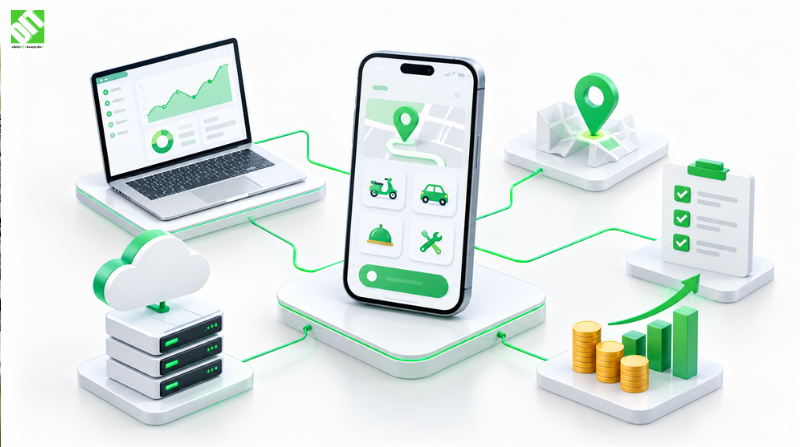
Learn how an on-demand app development company builds three-app platforms, sets dispatch and commission logic, and what to ask before you hire a vendor.
On-Demand App Development Company: Costs and Partner Tips
Most people who search for an on-demand app development company already have an idea in mind. They want a platform where people request a service and someone nearby fulfills it: a ride, a meal, a cleaner, a plumber, a tutor. What they often don't have yet is a clear picture of how that platform is actually structured, how it decides who gets which job, how money flows between the parties, and what separates a capable development partner from one that will hand over a product that works on launch day and breaks at the first busy weekend.
This guide covers those three areas. It explains the three-app model that nearly every on-demand platform is built on, walks through how dispatch and commission logic work, and lists the questions worth asking a vendor before you sign anything. If you want detailed breakdowns of specific categories, our taxi booking and food delivery guides go deeper into those verticals, so this article focuses on the structure they share.
What Is an On-Demand App?
An on-demand app connects people who need something now with people who can provide it now, usually within a defined area and time window. The defining feature is that the transaction happens in real time. A customer doesn't book a service for next Thursday. They request it, a system finds a suitable provider, the provider accepts, and the service is delivered while the customer watches its progress on their phone.
That real-time requirement changes the engineering. A booking website can tolerate a few seconds of delay and an occasional stale data point. An on-demand platform cannot. Provider locations update continuously, requests must be matched in seconds, and the status of a job has to be visible to at least three parties at once. Each of those requirements pushes the architecture toward real-time messaging, location processing, and event-driven backend services.
On-demand platforms share the same basic shape whether they move people, food, or labor. Demand arrives from one side, supply sits on the other, and a platform in the middle matches them, processes payment, and takes a cut. The business logic in that middle layer is where most of the complexity lives.
The Three-App Model: Customer, Provider, and Admin
Almost every serious on-demand platform separates its users into three applications, even when the company markets it as one product. Each app serves a different person with different goals, and trying to merge them into a single interface usually produces something that serves none of them well.
| Application | Who uses it | Core purpose | Typical screens and functions |
| Customer app | The person requesting a service | Request, track, pay, rate | Service selection, live tracking, payment, history, support |
| Provider app | Drivers, couriers, cleaners, technicians | Receive jobs, complete them, get paid | Online/offline toggle, job offers, navigation, proof of completion, earnings |
| Admin panel | Operations team, support staff, management | Run the marketplace | Live map, dispatch overrides, pricing rules, provider verification, disputes, reporting |
The customer app is the storefront. Its job is to make requesting a service feel effortless. The customer should be able to state what they need, see a realistic arrival time or completion window, understand the price before confirming, and follow the job without calling anyone. Most of the design effort here goes into reducing friction in the request flow and making the tracking screen trustworthy.
The provider app is the work tool. Providers often use it while driving, standing in a kitchen, or working in someone's home. It must be readable at a glance, usable with one hand, and reliable with intermittent connectivity. Battery consumption matters because location tracking runs in the background for hours. Providers also need clarity about earnings, because a provider who can't predict what a job pays will stop accepting jobs.
The admin panel is the control room. It is usually the least glamorous of the three and the one most often underbuilt. Operations teams need a live view of where supply and demand are, the ability to step in when a job stalls, tools to verify and suspend providers, a way to adjust pricing rules without a code release, and reporting that shows whether the marketplace is healthy. A platform without a capable admin panel can launch, but it becomes difficult to run once the first few hundred jobs have gone wrong in unexpected ways.
These three applications share a backend. Their data must agree with one another at all times. If a provider accepts a job in the provider app, the customer app must reflect that within moments, and the admin panel must show it on the map. Keeping these views consistent is one of the main reasons on-demand platforms need careful backend architecture from the start.
How Dispatch Works
Dispatch is the process of deciding which provider should receive which request. It sounds simple, but it is the heart of the platform, and the decisions made here shape customer satisfaction, provider earnings, and operating costs all at once.
A basic dispatch cycle usually looks like this:
A customer submits a request with a location, a service type, and sometimes a time preference.
The system identifies eligible providers nearby who are online, available, and qualified for that service.
The system ranks those providers by criteria such as estimated arrival time, rating, acceptance history, and current workload.
The top-ranked provider receives an offer with a short window to accept, often somewhere between 15 and 30 seconds.
If the provider accepts, the job is assigned, and the customer is notified with the provider's details and expected arrival.
If the provider declines or ignores the offer, the system moves to the next candidate.
If no provider accepts within the allowed attempts, the system widens the search radius, adjusts the price, or informs the customer that no provider is currently available.
Each step contains decisions. How far should the search radius expand before the platform gives up? Should a provider with a 4.9 rating and a long wait for acceptance rank above a provider with a 4.6 rating who responds immediately? How many offers should a single provider receive per hour before the system deprioritizes them? These are business rules, not just algorithms, and they should be configurable by the operations team rather than hardcoded by developers.
Dispatch also has to handle changes. A customer cancels. A provider's app loses connection. A job takes longer than estimated. A provider goes offline mid-job. Each scenario needs a defined response, and a well-designed system treats these exceptions as normal rather than as bugs.
Surge and Demand-Based Pricing
When demand exceeds supply, many on-demand platforms raise prices temporarily to attract more providers and moderate demand. This is commonly called surge pricing or dynamic pricing. The logic typically compares the number of active requests to the number of available providers within an area and adjusts a multiplier accordingly.
From a development standpoint, dynamic pricing needs to be transparent to the customer before confirmation, consistent in how it's calculated, and adjustable by the operations team. Customers who feel surprised by a price will cancel, and customers who feel the platform manipulates them will leave reviews. Many platforms also cap multipliers, notify customers of elevated prices, and offer scheduled alternatives during peak periods.
Commission Logic and How Money Flows
On-demand platforms earn revenue by taking a share of each transaction, a fee for the service of matching, payment handling, and support, or a combination of both. The commission model decides how much of each payment the platform keeps and how much reaches the provider, and it has direct consequences for both sides of the marketplace.
Common Revenue Models
| Model | How it works | Typical use |
| Percentage commission | The platform keeps a set share of each job's value | Ride-hailing, food delivery, marketplace services |
| Flat fee per job | The platform charges a fixed amount per completed transaction | Services with predictable job values |
| Subscription | Providers pay a recurring fee for access to the platform | Services where providers receive steady, high-volume work |
| Hybrid | A combination, such as a small subscription plus a lower commission | Platforms wanting predictable income and per-job revenue |
The right model depends on the market, the margins of the service, and how much providers are expected to earn. A percentage commission scales with transaction value, which suits high-value services, but it can feel punitive to providers on low-value jobs. A flat fee is easier for providers to understand but can be unfair when job values vary widely.
Commission rates vary significantly by category, competition, and local market conditions, so any specific figure should be tested against your own unit economics rather than copied from a competitor. What matters for the development partner is that the commission logic is configurable. Rates should be changeable without a new app release, applied differently by service category or region, and recorded in a way that makes every payout auditable.
The Payment Flow
A typical transaction moves through several stages. The customer authorizes payment when the request is confirmed or when the job completes, depending on the model. The platform holds the funds, calculates the commission, and records the split. Once the job is marked complete, the provider's share becomes eligible for payout on a schedule, such as daily, weekly, or on demand. Refunds, disputes, tips, and cancellation fees each need their own paths through this flow.
Payment processing is not a feature you build from scratch. It is an integration with a payment provider that handles card processing, fraud screening, and regulatory requirements. Your development partner's job is to design the internal ledger that tracks who is owed what, to handle the edge cases correctly, and to make sure reconciliation between the platform's records and the payment provider's records is possible. Errors here are expensive. A payout that goes to the wrong account or a commission applied twice can damage trust quickly.
Payouts to providers also raise tax and classification questions that vary by country. Whether providers are treated as independent contractors or employees changes how the platform must handle invoicing, tax documentation, and reporting. Those questions belong to legal and tax advisors, but the platform's data model should capture the information needed to answer them.
Core Features Across All Three Apps
While each on-demand category adds its own specifics, a common feature set appears across most platforms.
Customer app essentials
Account creation with phone or email verification, a request flow that captures location and service details, price estimation before confirmation, live tracking of provider location, in-app messaging or calling with privacy protection, payment method management, ratings, job history, and support access for disputes.
Provider app essentials
Verified onboarding with document checks, an online and offline toggle, job offers with accept and decline controls, turn-by-turn navigation handoff to a maps app, status updates at each stage of a job, proof of completion such as photos or confirmation codes, earnings overview, and payout management.
Admin panel essentials
Live map of supply and demand, job monitoring and manual reassignment, provider verification and suspension tools, pricing and commission configuration, promotional and discount management, dispute resolution workflows, customer and provider support tools, and analytics covering completion rates, cancellation reasons, utilization, and revenue.
Features beyond these essentials, such as subscriptions, loyalty programs, scheduled bookings, or AI-assisted matching, are worth adding once the core loop works reliably. Platforms that try to launch with everything usually delay their launch and discover that most advanced features see little use in the first months.
Technology Considerations
The exact technology stack depends on your requirements, scale, budget, integrations, and platform choices, so it should be decided through discovery rather than assumed in advance. That said, certain technology categories show up in nearly every on-demand platform.
Mobile frontends. Customer and provider apps are typically native or cross-platform mobile applications. The provider app, with its heavy use of location and background processing, usually demands the most careful native handling. The admin panel is typically a web application.
Real-time communication. Location updates, job status changes, and messaging all need a real-time channel, commonly built on WebSockets, push-based messaging services, or managed real-time platforms. This layer must remain responsive when thousands of providers send location updates simultaneously.
Location and mapping. Geospatial queries power matching, and mapping services power navigation and distance estimation. Costs for mapping APIs scale with usage, so the architecture should minimize unnecessary calls, such as caching routes and only recalculating when meaningful changes occur.
Backend services. Many platforms start as a well-structured monolith and move toward separate services for dispatch, pricing, payments, and notifications as load grows. Splitting too early adds operational overhead, while staying monolithic too long makes scaling harder. A good architect plans the boundaries from the beginning even if the first version doesn't split them.
Data and analytics. Operational data such as job records, provider activity, and location history grows quickly. Choosing storage that handles both transactional records and high-volume location data is important. Analytics should be designed in from the start because the operations team will need reliable metrics about utilization, wait times, and cancellation patterns.
Infrastructure. Peak demand on on-demand platforms is sharply uneven. Lunch hours, weekend evenings, and rainy days can multiply load within minutes. Cloud infrastructure with autoscaling, monitoring, and tested failover is a practical requirement, not a luxury.
The Development Process for an On-Demand Platform
On-demand platforms follow a standard software lifecycle, but several phases deserve particular attention because the risks are different from a typical business application.
Discovery and market definition. Before any design work, define the service, the geography, the supply model, and the economics. Who are the providers, and how are they recruited and verified? What is the customer's expectation for wait time? What share of each transaction must remain with the platform to sustain operations? Answers to these questions shape nearly every technical decision that follows.
Business and technical analysis. Translate the market decisions into system requirements. This includes defining the dispatch rules, pricing logic, commission structure, payment flows, and the data each app must capture. It's also the stage where integration needs are identified, such as payment providers, mapping services, identity verification, and messaging.
UX and UI design. Each of the three apps needs its own design work because each user has a different context. Customer flows should minimize steps, provider flows should work while the user is moving, and admin screens should surface problems quickly. Testing these designs with real representatives of each user group before development begins saves significant rework.
Architecture planning. Decide how the backend will handle real-time events, how location data will be stored and queried, how dispatch will scale, and how the system will recover from failures. This phase also defines the security model, including how providers' personal and identity data is protected.
Development. Build the three applications and the shared backend in parallel, with regular integration checkpoints so that the apps stay consistent with one another. Early working prototypes of the matching and tracking loop are valuable because they expose problems that design documents miss.
Integrations and testing. Connect payment processing, mapping, notifications, and identity verification. Test the platform under simulated load, including bursts of simultaneous requests and large numbers of active providers. Test failure scenarios such as dropped connections, payment failures, and providers going offline mid-job. Security testing should cover authentication, access control between customers and providers, and the protection of payment and personal data.
Deployment and launch. Many on-demand platforms launch in a single city or a limited zone. This is sensible because density matters: a platform with ten providers in a large city feels empty, while the same ten providers in a small district can serve customers well. Launch plans should include supply recruitment, provider onboarding support, and monitoring of the first weeks of operation.
Monitoring and continuous improvement. Once live, watch matching times, acceptance rates, cancellation patterns, and payment success. These numbers show where dispatch rules, pricing, or provider experience need adjustment. Plan for ongoing maintenance, since mobile operating systems, mapping services, and payment APIs all change over time.
Cost Factors
Costs for on-demand platforms vary widely, and no responsible vendor can quote an exact figure before understanding the scope. The main variables are the number of applications, the complexity of dispatch and pricing logic, the number of integrations, the platforms supported on each side, the real-time requirements, and the scale the platform must handle at launch and at maturity.
A platform that serves one service category in one city with straightforward pricing costs far less than a multi-category, multi-region marketplace with surge pricing, subscriptions, and automated provider verification. Within each of those scenarios, the choices about native versus cross-platform development, managed versus custom real-time infrastructure, and monolithic versus distributed backends make a substantial difference.
Ongoing costs deserve as much attention as build costs. Mapping and messaging API usage, cloud hosting, payment processing fees, identity verification checks, customer support staffing, and maintenance work continue for as long as the platform runs. A reliable estimate always includes operating costs over at least the first two years.
Choosing an On-Demand App Development Partner
The vendor you choose will shape the platform's architecture for years, so the selection process deserves careful attention. The following questions help separate partners who understand on-demand systems from those who have only built simple booking or e-commerce apps.
Questions about experience and approach
Have you built platforms where supply and demand must be matched in real time? Can you describe the hardest problem you solved in that work?
How do you structure the three applications so that they stay consistent with one another?
How do you handle dispatch rules that business teams need to change without a developer?
How do you approach discovery before development, and what do you expect from our team during that phase?
Questions about architecture and scale
How will the platform behave when demand spikes ten times above average, and how would you test that before launch?
Which parts of the system would you build as separate services, and which would you keep together at the start?
How will location data be stored, queried, and retained, and how does that affect cost?
What happens when a payment provider, mapping service, or messaging service has an outage?
Questions about money and operations
How would you design the internal ledger so that every commission, payout, refund, and adjustment is traceable?
Can commission rates and pricing rules be changed by our operations team without a code release?
What reporting would you build into the admin panel from day one?
Questions about security and compliance
How do you protect provider identity documents and personal data?
How do you prevent customers and providers from accessing each other's private information?
How would you support data protection requirements in the markets we plan to serve?
Questions about ownership and continuity
Who owns the source code, infrastructure accounts, and data at the end of the project?
What does post-launch support look like, and how are updates to mobile operating systems and third-party APIs handled?
How do you transfer knowledge to our internal team so we are not dependent on you indefinitely?
Pay attention to how vendors answer. A partner who immediately names a specific price, promises a launch date without discovery, or dismisses the admin panel as an afterthought is showing you how they will approach your project. Strong partners ask more questions than they answer in the first meeting, because the right architecture depends on details that only emerge through discovery.
Working With a Partner Across Time Zones
Many European businesses work with development teams in other time zones, and on-demand platforms can handle this well if the process is designed for it. Clear written requirements, shared task tracking, regular demos of working software, and defined overlap hours for decision-making make distributed development productive. DEIN IT TEAM, as the European partner brand of Cyberinfrastructure India (CIS), combines local project management in Europe with global engineering capacity through CIS, which is one way of structuring that collaboration. Whatever partner you choose, ask how overlap hours, communication rhythm, and decision authority are handled before work begins.
Common Mistakes to Avoid
Several patterns appear repeatedly in on-demand projects that struggle.
Launching in too many places at once. Thin supply in multiple cities produces poor service everywhere. Launching in one dense zone and expanding after the operation works is usually more effective.
Hardcoding business rules. When commission rates, dispatch radii, and pricing multipliers are buried in code, every adjustment becomes a development task and a release. Operations teams need control over these settings.
Underbuilding the admin panel. The first time a job goes wrong at scale, the operations team needs to see it, understand it, and fix it within minutes. An admin panel built as an afterthought creates expensive manual workarounds.
Ignoring provider experience. Providers are the supply side of the marketplace. If the provider app is hard to use or the earnings are unclear, providers leave, and customers wait longer for service.
Treating launch as the finish line. Matching quality, pricing fairness, and provider retention all need continuous attention after launch. Budget for that work from the beginning.
Conclusion
An on-demand platform is a three-sided system built around real-time matching. The customer app creates demand, the provider app delivers supply, and the admin panel keeps the marketplace running. Dispatch rules decide who receives which job, and commission logic decides how value is shared. Both need to be configurable, transparent, and tested under realistic conditions before you commit to a launch.
When you evaluate a development partner, look for experience with real-time marketplaces, a clear plan for the three applications and their shared backend, thoughtful answers about dispatch and payment design, and a serious approach to security and long-term support. Ask how they will handle peak demand, how your operations team will adjust rules without developers, and who owns the platform at the end.
If you are planning an on-demand platform and want to talk through the architecture, the business model, and the right way to structure the first version, you can discuss your project with DEIN IT TEAM. A discovery conversation is the most useful starting point, because the right design depends on the service, the market, and the economics behind your idea.
Frequently Asked Questions
What is an on-demand app development company?
An on-demand app development company builds platforms that connect customers with nearby providers in real time, such as ride-hailing, food delivery, or home services. Its work typically includes a customer app, a provider app, an admin panel, and the backend that handles matching, pricing, payments, and tracking.
How much does on-demand app development cost?
Costs depend on the number of applications, the complexity of dispatch and pricing logic, the integrations required, the platforms supported, and the scale the platform must handle. A single-city, single-service platform with straightforward rules costs far less than a multi-region marketplace with surge pricing and subscriptions. Ongoing costs for hosting, mapping and messaging APIs, payment fees, and maintenance should be included in any realistic budget. Exact figures require a scoped discovery phase.
What are the three apps in an on-demand platform?
The three apps are the customer app, where people request and track services, the provider app, where drivers or service workers receive and complete jobs, and the admin panel, where the operations team monitors the marketplace, manages providers, adjusts pricing, and resolves disputes. All three share a backend so their data stays consistent.
How does dispatch work in on-demand apps?
Dispatch identifies eligible providers near a customer's request, ranks them by criteria such as arrival time, rating, and responsiveness, and offers the job to the top candidate within a short acceptance window. If that provider declines or ignores the offer, the system moves to the next candidate. The rules governing ranking, search radius, and retry behavior should be configurable by operations staff.
How do on-demand platforms make money?
Most platforms take a percentage commission on each transaction, charge a flat fee per job, offer provider subscriptions, or combine these approaches. The right model depends on the service category, margins, and how providers are expected to earn. Commission rates should be tested against your own unit economics and kept adjustable.
Should I build a custom on-demand platform or use a white-label solution?
White-label platforms can launch faster with lower upfront cost but offer limited control over dispatch rules, pricing, and user experience, and they carry ongoing licensing fees. A custom platform costs more initially but gives you ownership of the code, the data, and the roadmap. The better choice depends on how differentiated your model is and how long you plan to operate.
What should I look for in an on-demand app development partner?
Look for experience with real-time marketplaces, a clear approach to the three-app architecture, specific answers about dispatch and payment design, a plan for peak-load testing, and a transparent position on source code ownership and post-launch support. Partners who ask detailed questions during discovery are usually more reliable than those who quote quickly without understanding your model.
Why do on-demand platforms often launch in one city first?
On-demand marketplaces depend on density. A small number of providers in a large area produces long waits and poor service, which drives customers away. Launching in one dense zone lets the platform deliver good service, learn from real operations, and refine its rules before expanding.
Recent Posts
October 16, 2026
October 14, 2026