IoT Development Company: How to Choose a Partner for Connected Products
Choosing an IoT development company? Use this checklist covering firmware, cloud, data pipelines, security, pilots and typical cost ranges.
The right IoT development company is one that can own the whole chain, from the sensor on the device to the dashboard on your screen, and is honest about where the hard parts sit. That means competence in embedded firmware, cloud architecture, data pipelines and security, plus a delivery approach that proves the idea in a small pilot before you commit a full budget.
That sounds obvious, yet many connected product projects go wrong at the seams. A team that is excellent at mobile apps may never have dealt with a device that loses connectivity for six hours. A hardware shop may ship solid firmware and leave you with a backend that cannot cope with ten thousand devices. This guide gives you a practical checklist for evaluating partners, realistic cost ranges, and a staged way to start so you can learn cheaply before you scale.
What an IoT Development Company Actually Does
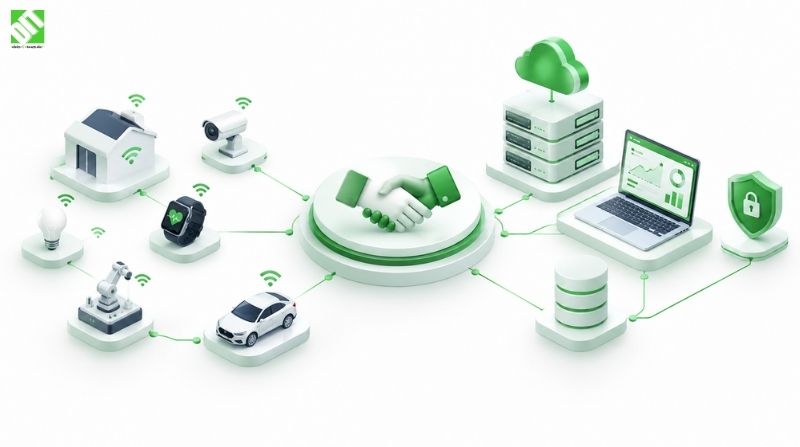
An IoT development company designs and builds systems in which physical devices collect data, send it over a network, and trigger actions or insights in software. It is not one discipline. It is at least four, working together.
Device layer: sensors, microcontrollers, gateways and the firmware that runs on them.
Connectivity layer: the protocols and networks (Wi-Fi, Bluetooth Low Energy, cellular, LoRaWAN and others) that move data off the device.
Platform layer: the cloud backend that ingests, stores, processes and manages devices and their data.
Application layer: dashboards, mobile apps, alerts and integrations with the systems your business already runs.
When people search for IoT software development, they usually mean the last two layers. But the software only works if the first two behave, which is why a partner’s ability to bridge hardware and software matters more than a long list of technologies on a services page.
If you are still at the stage of deciding whether IoT fits your operation, it helps to look at how companies in different sectors apply it. Our overview of how IoT is changing business operations across industries covers that ground, and this article assumes you are ready to talk to vendors.
Why Choosing the Wrong Partner Gets Expensive
IoT mistakes are harder to fix than normal software mistakes. A web app can be patched in an afternoon. A device already installed in a cold store, a vehicle or a factory floor cannot be recalled easily. A poor decision about hardware selection, message format or security model can follow you for years.
Three failure patterns show up again and again:
A prototype that never becomes a product. It works on a desk with ten devices and falls over at ten thousand.
Security added at the end. Default credentials, unsigned firmware and unencrypted traffic are common in rushed projects.
Data collected but never used. Devices send readings nobody has defined a use for, and cloud bills grow while value does not.
A good partner challenges you on these points early. That is a better sign than a polished proposal that agrees with everything.
The Partner Checklist: What to Evaluate
Use the five areas below as a scoring sheet. Ask each vendor to explain how they handle them, and listen for specifics rather than slogans.
Device and Firmware Capability
Firmware is the code that runs on the device itself. It is constrained by memory, power and processing limits, and it often has to keep working when the network does not.
Ask the vendor:
Which microcontroller families and real-time operating systems have they worked with, and can they work with the hardware you already selected?
How do they handle over-the-air (OTA) updates, including rollback if an update fails halfway?
What is their approach to power management for battery-driven devices?
How do they test firmware on real hardware, not only in simulation?
Do they design hardware themselves, or work with your hardware manufacturer? Either can be fine, but you need to know where the boundary is.
A vendor with no clear answer on OTA updates is a risk. Devices in the field will need patches, and the update mechanism should be designed on day one.
Cloud Platform and Architecture
IoT platform development is the work of building the backend that connects and manages your devices. Its core jobs are device registration and identity, message ingestion, storage, rules and processing, and exposing data to applications.
You can build on a major cloud provider’s IoT services, use a dedicated IoT platform, or build a more custom backend. None of these is universally right. The decision depends on how many devices you expect, how specialised your logic is, how much vendor lock-in you can accept, and what your team already runs.
Questions worth asking:
How would they decide between a managed IoT service and a custom build for your case?
How do they design for scale, and have they planned for the jump from hundreds to many thousands of devices?
How is device identity and provisioning handled at manufacturing time?
What does their approach to cloud integration look like when your IoT data has to connect with ERP, CRM or analytics tools you already use?
Be wary of anyone who recommends a platform before understanding your device count, data volume and integration needs.
Data Pipeline and Analytics
A data pipeline is the path a reading takes from the device to a decision. Typically that includes ingestion, validation, storage (often a time-series database for sensor data), processing, and then visualisation or alerting.
This is where many projects quietly lose value. Ask the vendor:
How do they handle bad, duplicate or out-of-order data?
Do they separate hot data (needed in seconds) from cold data (kept for analysis)? This has a large effect on cloud costs.
How would they handle edge processing, where the device or a gateway filters data before sending it?
Can they support machine learning use cases, such as predictive maintenance or anomaly detection, once enough data exists?
A strong partner will also ask what decision each data point supports. If nobody can say, you probably should not collect it yet.
Security
IoT security covers the device, the network, the cloud and the people with access. Weak spots at any layer expose the others.
The baseline a credible partner should meet includes:
Unique credentials per device, never shared or default passwords
Encrypted communication between device and cloud
Secure boot and signed firmware updates
Role-based access control in the platform and applications
Logging and monitoring so unusual device behaviour is noticed
A plan for end-of-life, such as revoking credentials for decommissioned devices
Depending on your market, regulation may apply to connected products, including EU cybersecurity and data protection requirements. A good vendor will raise this before you do and will not offer legal advice they are not qualified to give. They should know which questions to take to your compliance team.
Pilot Approach and Delivery Model
How a vendor starts tells you how they will finish. The strongest signal is a willingness to propose a pilot with clear success criteria instead of pushing for a large fixed-scope contract on day one.
Look for:
A discovery phase that defines the business goal, device requirements and measurable outcomes
A pilot with a limited number of devices in a real environment
Agile delivery with regular demos you can actually see working
Transparent communication, including a named project manager in your time zone
Flexible engagement models, so you can scale the team as the project evolves
A clear handover and a maintenance plan after launch
How a Sensible IoT Project Is Staged
A staged approach protects your budget and gives everyone real data before the big decisions are locked in.
Discovery and use case definition. Agree on the problem, the users, the data needed and the success metrics. Decide what counts as a pass or fail for the pilot.
Architecture and technology selection. Choose protocols, platform approach and security model. This is the cheapest stage to change your mind.
Proof of concept. Build the thinnest possible end-to-end version: a few devices, data reaching the cloud, a basic dashboard.
Pilot in a real environment. Run it with real conditions: poor connectivity, temperature swings, actual users. This is where assumptions break.
MVP or production build. Harden firmware, scale the platform, build the full application and integrations.
Rollout, monitoring and iteration. Deploy in waves, monitor device health and refine based on usage.
Logistics is a good illustration. A company tracking refrigerated shipments might first fit sensors to twenty vehicles on one route, check whether temperature and location data arrive reliably, and only then decide whether to roll out to the fleet. This is an illustrative scenario, not a client project, but the logic applies in most sectors.
IoT Development Cost: What to Expect
The honest answer to “how much does IoT development cost?” is that it depends on scope, and anyone quoting a single figure without questions is guessing. That said, the ranges below are typical planning estimates for software and integration work in the European market. They are not quotes, and they exclude the cost of the physical hardware itself.
| Stage | Typical range (EUR) | What it usually covers |
| Discovery and architecture | 5,000 to 20,000 | Requirements, technical design, platform choice, project plan |
| Proof of concept | 15,000 to 50,000 | A few devices, basic cloud ingestion, simple dashboard |
| Pilot | 30,000 to 80,000 | Real-environment testing, firmware refinement, core app features |
| MVP / first production release | 60,000 to 180,000 | Hardened firmware, scalable backend, web or mobile app, integrations |
| Full platform at scale | 180,000 to 400,000 and above | Multi-tenant platform, advanced analytics, large device fleets, multiple integrations |
| Annual maintenance and support | Often 15 to 25 percent of build cost | Updates, monitoring, security patches, cloud tuning |
Ranges overlap because stages overlap. A simple monitoring product may reach production for less than the figures above, while a regulated or safety-critical product will exceed them.
What Drives the Cost Up or Down
Hardware complexity: custom hardware and firmware cost far more than integrating off-the-shelf devices.
Number of device types: each new device model adds firmware, testing and provisioning work.
Connectivity choices: cellular and low-power wide-area networks add carrier and certification considerations.
Real-time requirements: the faster the data must arrive and act, the more architecture work is needed.
Integrations: connecting to ERP, CRM and legacy systems is often larger than expected.
AI and analytics: predictive models need data, tuning and ongoing monitoring.
Security and compliance: stronger requirements mean more design, testing and documentation.
Cloud running costs: these are recurring and depend on message volume, storage and processing.
Team location and composition: blended teams with local project management and wider engineering capacity can control cost without losing accountability.
One tip: ask vendors to separate build cost from run cost. A cheap build that creates a expensive cloud bill is not cheap.
Custom Build, Platform or Hybrid?
Many buyers ask whether to build on an existing IoT platform or develop a custom solution. The practical answer is often a hybrid.
| Approach | Best for | Watch out for |
| Off-the-shelf IoT platform | Standard monitoring, fast time to market | Limited flexibility, licence costs that grow with devices |
| Managed cloud IoT services with custom applications | Most business use cases | Needs solid architecture to avoid lock-in surprises |
| Fully custom backend | Unusual logic, strict data control, very large scale | Higher upfront cost and longer timeline |
A capable partner will explain the trade-offs for your case and will not default to whichever option is easiest for them to deliver.
Red Flags When Comparing IoT Vendors
Some warning signs are easy to spot once you know them:
They talk about apps and dashboards but are vague about firmware and hardware.
There is no mention of security until you ask.
They propose a large fixed-scope project with no pilot.
References are generic, or they cannot explain what part of a project they personally delivered.
They recommend a technology stack before discovery.
Maintenance and OTA updates are treated as an afterthought.
Pricing is a single number with no breakdown.
Where Software Engineering Practice Matters
IoT teams that treat the project as pure hardware or pure software tend to struggle. Connected products need continuous delivery for both cloud and firmware, automated testing, staged rollouts of updates, and monitoring that shows device health in the field. Mature DevOps practices are what make it safe to push an update to thousands of devices without holding your breath. When you interview vendors, ask to see how they release, test and monitor, not only how they design.
Conclusion
Choosing an IoT development company comes down to a few practical questions. Can they handle firmware as well as software? Is the cloud architecture designed for the scale you expect? Is there a clear plan for the data, for security, and for updating devices after launch? And will they start with a pilot that proves value before you commit the larger budget?
Your next steps are straightforward. Write down the business problem and the decision the data should support. Shortlist two or three vendors and score them against the five areas above. Ask for a staged proposal with separate build and run costs. If you want to talk through a connected product idea or an existing pilot, you can discuss your project with the DEIN IT TEAM and get an honest view of scope, risks and sensible first steps.
Frequently Asked Questions
What does an IoT development company do?
It designs and builds systems that connect physical devices to software. That includes device firmware, connectivity, a cloud platform for data and device management, and applications such as dashboards, mobile apps and integrations with business systems.
How much does IoT development cost?
For software and integration work, a proof of concept often falls between 15,000 and 50,000 EUR, and a production MVP between 60,000 and 180,000 EUR. Large platforms can go well beyond that. Hardware, cloud running costs and maintenance are additional, and actual cost depends on scope.
How long does it take to build an IoT solution?
A proof of concept commonly takes one to three months. A pilot adds another two to four months, and a production-ready MVP usually takes six to twelve months in total. Custom hardware, certification and complex integrations extend this.
Which platform is best for IoT development?
There is no single best platform. Major cloud providers’ managed IoT services suit many business cases, dedicated IoT platforms speed up standard use cases, and custom backends suit unusual requirements or very large scale. The right choice depends on device count, data volume, integrations and lock-in tolerance.
How secure are IoT solutions?
Security depends on how they are built. A well-designed solution uses unique device credentials, encrypted communication, signed firmware updates, role-based access and monitoring. Weak implementations that skip these basics are a common source of incidents.
Can IoT systems integrate with existing software like ERP or CRM?
Yes. IoT platforms typically expose data through APIs and message queues, which can feed ERP, CRM, analytics and reporting tools. Integration effort varies with the age and openness of the existing systems.
Should I build a custom IoT platform or use an off-the-shelf one?
Off-the-shelf platforms are faster for standard monitoring needs. Custom or hybrid builds make sense when you need unique logic, tighter control over data, or cost control at large device volumes. Many projects combine managed cloud services with a custom application layer.
Why start with a pilot instead of a full build?
A pilot tests your assumptions in real conditions with a small number of devices. It exposes connectivity, data quality and usability problems while they are still cheap to fix, and it gives you evidence to justify the larger investment.