Hotel Booking App Development: Features, Cost and Timeline
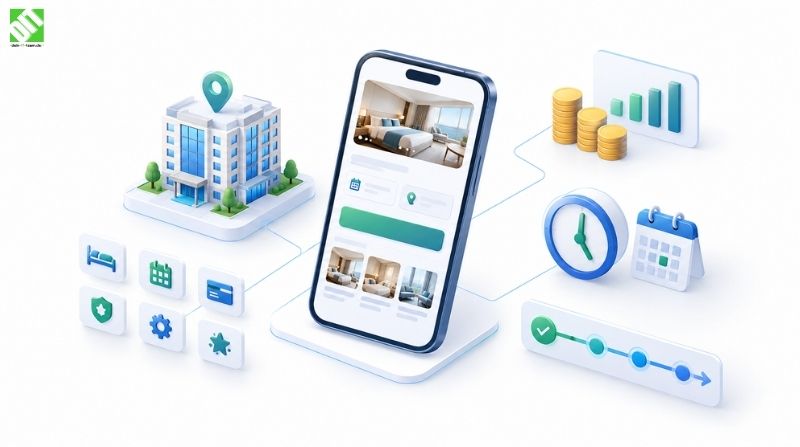
Hotel booking app development explained: core features, cost drivers, and a phased MVP plan with realistic timelines for hotels, OTAs, and startups.
Hotel booking app development means designing and building a mobile or web application that lets guests search for rooms, check live availability, pay, and manage reservations, while giving hotel staff a back-end to control inventory, rates, and bookings. A focused MVP usually takes 3 to 5 months. A full platform with channel manager sync, loyalty features, and multi-property support takes 8 to 12 months or more. Cost depends mostly on scope, integrations, and the number of platforms.
Those numbers hide a lot of variation, so this guide explains what is actually inside a hotel booking product, which decisions move the budget, and how to phase the build so you launch something useful before you have spent everything. It covers core features, the admin side, cost drivers, a phased MVP plan, and the mistakes that most often delay these projects.
What a Hotel Booking App Actually Does
A hotel booking app is more than a search box and a pay button. Underneath, it is an inventory system. Every room type has a count, every night has a rate, and every booking must reduce availability in real time without ever selling the same room twice.
That is why hotel booking systems are harder than they look. The guest sees a simple flow, but the app is constantly reconciling availability, pricing rules, tax, cancellation policies, and payment status.
It also helps to be clear about which type of product you are building, because the scope changes a lot:
| Product type | Who uses it | Typical complexity |
| Single hotel or chain direct booking app | Guests of one brand | Moderate |
| Multi-property platform | Hotel groups, resort operators | High |
| Online travel marketplace (OTA style) | Travelers and many hotel partners | Very high |
| Niche booking app (boutique stays, hostels, serviced apartments) | Specific traveler segment | Moderate to high |
A direct booking app for one property is mainly about conversion and operational accuracy. A marketplace adds hotel onboarding, commissions, partner payouts, and dispute handling on top. Decide early which one you are building, because it shapes every estimate that follows.
Core Features of a Hotel Booking App
The features that matter most fall into two groups: what the guest sees, and what the hotel team controls. Both need to be designed together.
Search and Discovery
Search is where most booking journeys succeed or fail. Guests expect to enter a destination and dates, then filter results quickly.
A solid search module typically includes:
Destination, date range, and guest count inputs with sensible defaults
Filters for price, star rating, amenities, property type, and guest score
Map view with nearby points of interest
Sorting by price, distance, and popularity
Saved searches and wishlists
Fast results, since slow search pages lose bookings quickly
Behind the scenes, search needs an index that can answer availability queries quickly. Querying the main database for every search works at small scale and breaks as traffic grows, so planning a search layer early saves rework.
Room Inventory and Availability
This is the heart of the system. Each property has room types (for example, standard double, deluxe, suite), each with a quantity and its own attributes. The app must track availability per night and update it the moment a booking is made, modified, or canceled.
Key considerations include handling simultaneous bookings for the last available room, holding a room for a few minutes during checkout, and releasing the hold if payment fails. Getting this wrong leads to overbookings, which cost money and damage trust.
Rates and Pricing Rules
Hotel pricing is rarely a single number. A usable rate engine needs to support:
Base rates by room type and date
Seasonal and weekend pricing
Length-of-stay rules and minimum stay requirements
Promotional codes and member discounts
Taxes, service charges, and local fees
Different cancellation policies per rate plan (flexible, non-refundable, and so on)
Dynamic pricing, where rates adjust based on demand, occupancy, or events, is a common later-phase addition. It can start as simple rules and evolve toward AI-driven recommendations once you have enough booking data.
Booking Flow and Guest Accounts
The booking flow should be short. Every extra field lowers conversion. Offer guest checkout alongside account creation, show the full price including taxes before the final step, and send a confirmation by email and in-app notification immediately.
Guest accounts add value through saved details, booking history, easy modifications, and loyalty points. They are worth including in the MVP only if repeat bookings are central to your model.
Payments
Payment is where the flow touches real money and real risk. A hotel booking app typically needs to support cards, digital wallets, and local payment methods depending on the market. It also needs to handle:
Full prepayment, deposits, and pay-at-property options
Pre-authorization holds for the stay
Refunds and partial refunds based on cancellation policy
Multiple currencies where you serve international guests
Secure tokenization so card data never touches your own servers
Using an established payment gateway is the standard route, and it keeps most of the PCI compliance burden off your system. The gateway you choose affects fees, supported regions, and how refunds and disputes work, so it deserves a proper evaluation rather than a last-minute pick.
Notifications, Reviews, and Support
Booking confirmations, reminders, check-in instructions, and post-stay review requests all raise satisfaction and reduce no-shows. Ratings and reviews build trust, but they need moderation tools. In-app chat or a support ticket flow is useful, especially for same-day changes.
The Admin Panel: The Part Guests Never See
Many projects underinvest in the admin side, then discover that hotel staff cannot run the business with it. A good admin panel is what makes the app operationally viable.
Essential admin capabilities include:
Property and room type management, including photos, descriptions, and amenities
Calendar view of availability, with the ability to block rooms for maintenance
Rate and promotion management
Booking list with filters, manual booking entry, modification, and cancellation
Guest records and communication history
Role-based access for front desk, revenue managers, and administrators
Reports on occupancy, revenue, cancellations, and booking sources
Payout and commission tracking if you operate a marketplace
For a hotel group or marketplace, add partner onboarding, document verification, and per-property permissions. Reporting is also worth planning early, since revenue managers will judge the whole product by whether they can trust its numbers.
Integrations That Shape Scope
Most real-world hotel booking products connect to other systems. Each integration adds design, build, and testing effort, so they are one of the biggest cost levers.
Common integrations include:
Property management systems (PMS): to sync reservations and room status with front desk operations
Channel managers: to keep availability and rates consistent across your app and third-party distribution channels
Payment gateways: covered above
Maps and geolocation: for search, directions, and nearby places
Email, SMS, and push notification services
Analytics and CRM tools: for marketing and guest relationship management
Accounting systems: for invoicing and reconciliation
If you are building for a hotel that already runs a PMS, the integration is often the most important technical task in the project, not the guest-facing screens. A well-planned API development and integration layer keeps these connections maintainable and means you can add a new channel or system later without rewriting the core booking logic.
Hotel Booking App Development Cost: What Actually Drives the Budget
The honest answer to “how much does it cost” is that it depends on scope, and anyone quoting a single number without understanding your requirements is guessing. What can be explained clearly is why budgets differ so much, and that also answers the common question about hotel booking website development cost, since a web build and an app build share most of the same back-end work.
| Cost driver | Why it affects the budget |
| Number of platforms | iOS, Android, and web each need development and testing. Cross-platform approaches reduce duplication but do not remove it |
| Feature depth | A basic search and booking flow costs far less than loyalty programs, dynamic pricing, and multi-currency support |
| Integrations | PMS, channel manager, and payment integrations often take longer than expected because of third-party documentation and testing constraints |
| Admin panel complexity | Role-based access, reporting, and multi-property management add significant work |
| UI/UX design | Custom design, user research, and usability testing cost more than template-based interfaces but affect conversion directly |
| Real-time behavior | Live availability, inventory holds, and instant notifications need careful backend design |
| Security and compliance | Payment security, data protection requirements, and audit logging add effort, especially for European guests under GDPR |
| Infrastructure | Hosting, scaling, monitoring, and backups continue after launch as ongoing costs |
| Team composition and location | Rates vary by region, seniority, and engagement model |
| Maintenance | Bug fixes, OS updates, security patches, and new features typically continue after launch |
A useful way to think about it: a lean MVP covers search, booking, payment, and a basic admin panel for one property or a small group. A mid-range product adds integrations, richer admin tools, and loyalty features. A marketplace-scale platform adds partner management, commissions, and advanced analytics, and sits in a different budget category altogether.
Plan for post-launch spending as well. Maintenance, hosting, and iterative improvements are part of the real cost of owning a booking product, not extras.
Hotel Booking App Development Timeline
A realistic timeline depends on scope, but these ranges are a reasonable starting point for planning:
| Scope level | Typical duration |
| Lean MVP (one property or small group, core booking and payment) | 3 to 5 months |
| Mid-range product (integrations, loyalty, richer admin) | 5 to 8 months |
| Marketplace or multi-property platform | 8 to 12 months or more |
These figures assume reasonably quick decisions on your side. The most common causes of delay are unclear requirements, late changes to pricing rules, and slow access to third-party integration credentials.
A Phased MVP Plan for a Hotel Booking App
Trying to build everything before launch is the most expensive way to learn what guests actually want. A phased plan reduces risk and gets you real booking data sooner.
Discovery and requirements (2 to 4 weeks). Define your business model, target guests, property types, and must-have features. Map the booking journey and the admin workflows. Decide on integrations and compliance needs. This phase prevents the costly rework that comes from building on assumptions.
UX and UI design (3 to 5 weeks). Create wireframes and clickable prototypes for the search, booking, and admin flows. Test them with a few real users before development begins. Good UI/UX design here has an outsized effect on booking conversion later, which makes it worth the time.
MVP development (8 to 12 weeks). Build the core: search, room inventory, rate management, booking flow, payment integration, confirmation emails, and a basic admin panel. Keep the feature list tight.
Testing and QA (3 to 4 weeks, overlapping with development). Test availability logic under concurrent bookings, payment edge cases such as failed or duplicate payments, and cancellation and refund rules. Include security testing and performance testing on search.
Launch and monitoring (1 to 2 weeks). Release to a limited audience or a single property first. Monitor errors, booking completion rates, and payment success rates.
Phase two enhancements (ongoing). Add based on real usage: PMS and channel manager sync, loyalty features, reviews, dynamic pricing, multi-language and multi-currency support, and richer analytics.
The principle is simple: launch the smallest version that can take a real booking and collect payment correctly, then expand where the data points.
Technology Considerations
The exact technology stack should follow your requirements rather than a fixed template. The categories to decide on are:
Frontend: native or cross-platform mobile framework, plus a web framework
Backend: application server and business logic for inventory and pricing
Database: relational storage for bookings and inventory, often paired with a search index
API layer: for the app, admin panel, and third-party systems
Authentication: secure login, session management, and role-based permissions
Payment gateway: chosen for regional coverage, fees, and refund handling
Maps and notifications: location services, email, SMS, and push messaging
Hosting and DevOps: infrastructure, deployment automation, monitoring, and backups
Scalability matters more for booking products than people expect, because demand is spiky. A promotion, holiday period, or event can multiply traffic quickly. Thinking through cloud architecture and integration before launch helps the platform handle those peaks without slow searches or failed bookings.
Security and Compliance Basics
Booking apps handle personal data, travel dates, and payment details, so security is a design requirement from day one. The essentials are:
Encrypted data in transit and at rest
Payment tokenization through your gateway, so raw card data is never stored
Strong authentication and role-based access in the admin panel
Audit logs for sensitive actions such as refunds and rate changes
GDPR-aligned consent, data retention, and deletion processes where you serve EU guests
Regular security testing and dependency updates after launch
Treating these as launch blockers rather than later improvements is far cheaper than retrofitting them.
Common Mistakes in Hotel Booking App Development
A few problems show up repeatedly:
Underestimating inventory logic. Overbookings and rate mismatches are the most damaging bugs in this category.
Skipping the admin panel design. If staff find it slow or confusing, they work around it, and your data stops being reliable.
Leaving integrations until the end. PMS and channel manager connections often reveal constraints that should have shaped the architecture.
Overbuilding the MVP. Loyalty programs and AI pricing are valuable, but not before you have proven that guests complete bookings.
Ignoring post-launch costs. Hosting, updates, and support continue as long as the product runs.
Marketplace-style products share many of these patterns, from two-sided user management to payment splitting and real-time status updates. If you want to see how a similar multi-party product is planned and scoped, this overview of building a food delivery app walks through a comparable feature, cost, and timeline breakdown.
Build Custom or Use an Off-the-Shelf Booking Platform?
Off-the-shelf booking engines are faster to launch and cost less upfront, and they suit a single independent hotel with standard needs. Custom development makes sense when you need a distinctive guest experience, unusual pricing logic, deep integration with existing systems, ownership of your guest data, or a marketplace model. The trade-off is higher initial investment and a longer path to launch, balanced against long-term flexibility and no dependence on a vendor’s roadmap or fees.
A hybrid path also works: start with a custom MVP focused on your differentiating features, and integrate proven components such as the payment gateway rather than building them yourself.
Conclusion
Successful hotel booking app development comes down to a few disciplined choices. Get inventory and rate logic right, keep the first release focused on search, booking, payment, and a workable admin panel, and treat integrations, security, and scalability as design inputs rather than afterthoughts. Cost and timeline follow from scope, so the most effective way to control both is to define the smallest launchable version and expand from real usage.
A sensible next step is to write down your business model, the property types you serve, your must-have features, and the systems the app must connect to. That one-page brief makes any estimate far more accurate. If you would like to pressure-test your scope or get a realistic plan for your MVP, you can discuss your project with the DEIN IT TEAM, and the team can help you turn the idea into a phased, buildable roadmap.
Frequently Asked Questions
What is hotel booking app development?
It is the process of designing and building a mobile or web application that lets guests search for rooms, check live availability, pay, and manage bookings, along with an admin system for hotel staff to manage inventory, rates, and reservations.
What features should a hotel booking app include?
At minimum: search with filters, live room availability, rate and pricing management, a short booking flow, secure payments, booking confirmations, and an admin panel. Later additions include loyalty programs, reviews, dynamic pricing, and PMS or channel manager integration.
How much does hotel booking app development cost?
There is no single figure, because cost depends on scope. The main drivers are the number of platforms, feature depth, third-party integrations, admin panel complexity, security requirements, and team location. A lean MVP costs considerably less than a multi-property or marketplace platform.
How much does hotel booking website development cost compared to an app?
The back-end work (inventory, rates, bookings, payments, admin) is largely shared, so a website and an app cost similar amounts for that portion. The difference comes from front-end work: a website needs one responsive build, while native apps need separate iOS and Android effort unless a cross-platform approach is used.
How long does it take to build a hotel booking app?
A focused MVP usually takes 3 to 5 months. A mid-range product with integrations takes around 5 to 8 months, and a marketplace-scale platform can take 8 to 12 months or longer.
Can a hotel booking app integrate with an existing PMS or channel manager?
Yes. Most production booking apps connect to a property management system and often a channel manager to keep availability, rates, and reservations consistent. The effort depends on the quality of the third-party APIs and the integration scope.
How do hotel booking apps prevent double bookings?
They track availability per room type per night and use temporary inventory holds during checkout, so a room cannot be sold twice. The hold is released automatically if payment fails or the session expires.
Is it better to build a custom hotel booking app or use an existing platform?
Existing platforms suit standard needs and fast launches. Custom development fits when you need unique features, deeper integrations, control of guest data, or a marketplace model. Many teams start with a custom MVP and integrate existing services such as payment gateways.