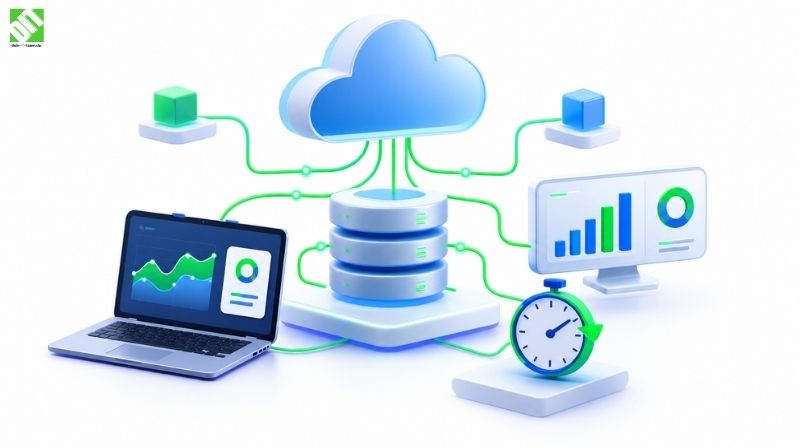
Fleet Management Software Cost: Features, Pricing Factors and Timeline
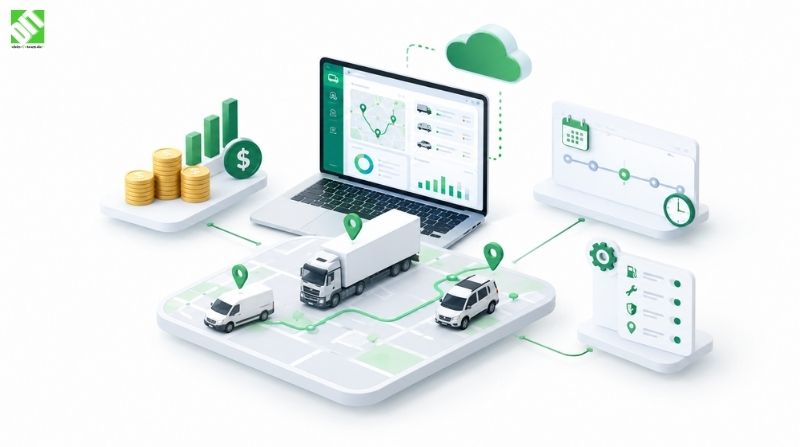
Fleet management software cost explained by module, from tracking to reporting. Compare custom build vs SaaS, see timelines and phased delivery.
Fleet management software cost depends mostly on one decision: do you subscribe to an existing SaaS platform, or build something around your own operation? As a rough guide, SaaS typically runs from about €15 to €45 per vehicle per month, while a custom build usually lands between €35,000 for a lean first release and €250,000 or more for a full platform. Those numbers move a lot with scope, so the useful question is what drives them.
This guide breaks the cost down module by module (tracking, driver app, dashboard, maps and reporting), compares SaaS with custom development, and explains how phased delivery keeps the budget under control. All figures are indicative planning ranges, not quotes. A real estimate needs your fleet size, workflows and integrations.
What Does Fleet Management Software Cost?
The short answer: a custom fleet management system typically costs €35,000 to €80,000 for a first release (MVP) and €65,000 to €195,000 or more for a full platform with every core module. SaaS subscriptions cost roughly €15 to €45 per vehicle per month, plus hardware.
| Route | Typical cost | Typical time to start using it |
| SaaS subscription | €15 to €45 per vehicle per month, plus tracking devices | Days to a few weeks |
| Custom MVP | €35,000 to €80,000 | 3 to 5 months |
| Custom full platform | €65,000 to €195,000+ | 6 to 12 months |
| Annual upkeep for custom | Around 15 to 20 percent of build cost | Ongoing |
Neither route is automatically cheaper. A 20-vehicle fleet with standard needs will almost always do better on SaaS. A 300-vehicle fleet with unusual dispatch rules, several depots and a legacy ERP often pays less over five years with software built for it.
What Actually Drives Fleet Management Software Development Costs
Before the module breakdown, it helps to see what moves the price. Two projects with the same feature list can differ by 2x because of the following.
Number of platforms. A web dashboard alone is cheaper than a dashboard plus iOS and Android driver apps. Cross-platform development reduces cost compared with two native apps, though some projects still justify native for device-level features.
Real-time requirements. Showing a vehicle position that refreshes every few seconds is a very different engineering problem from updating it every few minutes. Real-time pipelines need message queues, WebSockets or similar streaming, and careful load handling.
Data volume. One hundred vehicles sending a position every 5 seconds produce millions of records per day. Storage design, indexing and archiving strategy all affect cost.
Hardware diversity. Supporting one brand of GPS tracker is simple. Supporting OBD-II dongles, CAN bus readers, fuel sensors, temperature probes and phone-based tracking at once multiplies the integration work.
Integrations. Connecting to an ERP, a TMS, fuel card providers, payroll or customer portals is often where budgets quietly grow. Good custom software development planning identifies these integrations in the first weeks, not in month five.
Security and compliance. Driver location data is personal data. In the EU, that means GDPR obligations, role-based access, audit logs, retention rules and, in some countries, works council agreements. Building these in from the start costs far less than retrofitting.
Team setup and timeline. A compressed schedule needs more people in parallel, which raises the monthly burn even if total effort stays the same.
Cost Breakdown by Module
This is where most buyers want clarity. The ranges below assume a custom build with a reasonable level of polish, not a prototype.
| Module | Indicative cost | Typical build time |
| Vehicle tracking and telematics ingestion | €12,000 to €35,000 | 4 to 8 weeks |
| Driver mobile app | €15,000 to €45,000 | 6 to 10 weeks |
| Admin web dashboard | €12,000 to €30,000 | 4 to 8 weeks |
| Maps, routing and ETA | €8,000 to €30,000 | 3 to 8 weeks |
| Reporting and analytics | €8,000 to €25,000 | 3 to 6 weeks |
| Backend core, user roles, integrations | €10,000 to €30,000 | 4 to 8 weeks |
Modules overlap in practice, so timelines do not simply add up. Let’s go through each one.
Vehicle Tracking and Telematics
Tracking is the heart of most fleet systems. At its simplest, it receives GPS coordinates from a device or phone, stores them and draws them on a map. The real work sits underneath:
Reading data from different tracker protocols and normalizing it into one format
Handling dropped connections, delayed packets and duplicate messages
Geofencing (alerts when a vehicle enters or leaves an area)
Speed, idling, harsh braking and route deviation events
Trip history and replay
A basic version using phone-based tracking costs less because you skip hardware integration. A version that reads engine diagnostics, fuel levels and temperature sensors costs more because each sensor type needs its own parsing and validation logic. If your fleet relies on connected devices, IoT development becomes a meaningful part of the scope, and it is worth deciding early which hardware you will support.
Driver App
The driver app is what makes the system a two-way tool instead of a passive tracker. Drivers use it to receive jobs, confirm pickups and deliveries, run vehicle inspection checklists, log breaks, report incidents and capture proof of delivery with photos or signatures.
Cost rises with offline support (drivers lose signal in tunnels and rural areas, so the app must queue actions and sync later), background location tracking, push notifications and in-app messaging. Battery drain is a real design issue here. Continuous GPS can empty a phone in a few hours if it is not tuned properly, and drivers will stop using an app that does that.
Most fleet operators choose cross-platform mobile app development for the driver side, since the feature set is practical and the audience is internal. Usability matters more than visual flair. Drivers work with one hand, in a moving or parked vehicle, often in a hurry, so large tap targets and short flows save more money than any animation will.
Admin Dashboard
The dashboard is where dispatchers and managers live all day. A solid version includes a live map with filters, a vehicle and driver list, job assignment, alerts, user management and basic settings.
Costs grow with the number of user roles (dispatcher, depot manager, finance, customer), multi-depot or multi-company support, and custom workflows such as approval chains. Performance also matters. A map showing 500 moving vehicles has to stay smooth, which takes deliberate front-end engineering such as clustering and efficient update batching.
Maps, Routing and ETA
Maps look simple because users are used to consumer navigation apps. Building the equivalent for business use involves several separate pieces: map display, geocoding (turning addresses into coordinates), route calculation, traffic-aware ETAs and, for larger operations, route optimization across many stops and vehicles.
Most teams use a third-party maps provider instead of building their own mapping engine. That keeps development cost down but introduces a running cost: map and routing APIs charge by usage, and a busy fleet can generate a noticeable monthly bill. This should be modeled during planning. Truck-specific routing (height, weight, hazardous goods restrictions) costs extra and is often essential for freight.
Route optimization is the biggest swing factor in this module. Simple stop sequencing is inexpensive. Optimization that balances time windows, vehicle capacity, driver hours and live traffic is a project in itself, and some operators add it only in a later phase.
Reporting and Analytics
Reports turn raw data into decisions. Typical outputs include distance and fuel use per vehicle, driver behavior scores, on-time delivery rates, idle time, maintenance history and cost per kilometer.
Fixed reports are cheap to build. Configurable reports, scheduled email exports and self-service dashboards cost more. If you plan to add predictive features later, such as maintenance forecasting, make sure the data model captures enough history from day one. AI development works only as well as the data under it, so it pays to store clean, well-structured event data from the first release.
Custom Build vs SaaS: Which Costs Less?
SaaS wins on speed and upfront cost. Custom wins on fit and long-term control. The honest comparison depends on fleet size, uniqueness of workflows and how long you will use the system.
| Factor | SaaS platform | Custom fleet system |
| Upfront cost | Low | Higher |
| Ongoing cost | Grows with every vehicle | Hosting, maintenance, improvements |
| Time to launch | Fast | Months |
| Fit to your workflow | Configured, within limits | Built around your process |
| Integrations | Whatever the vendor supports | Anything with an API |
| Data ownership | Vendor-hosted | Yours |
| Differentiation | None, competitors use the same tool | Possible |
A simple way to test the numbers: take your vehicle count, multiply by a realistic per-vehicle subscription, then by 12 and by five years. For 150 vehicles at €25 per month, that is €225,000 over five years, and the fee keeps rising as you add vehicles. A custom system with a €120,000 build and around €20,000 per year in upkeep comes to about €220,000 over the same period, with features tailored to your operation. The break-even point shifts based on your inputs, but the exercise often reveals that mid-sized fleets sit closer to the line than they expect.
Custom development also makes sense when software is part of your service. If you are a logistics provider offering customers live tracking and branded portals, owning the platform becomes a product decision, not just a cost decision. The same logic applies to broader logistics tooling, and what logistics software development costs in 2026 covers the wider picture beyond fleet-specific features.
There is also a hybrid route. Some companies keep a SaaS tracker for the basics and build a custom layer on top for dispatch, customer portals or reporting. This can work well, provided the SaaS vendor offers solid APIs.
Phased Delivery: How to Spread Cost and Reduce Risk
Building everything at once is the most expensive way to find out what you did not need. Phased delivery lets you launch something useful early, learn from real usage and fund later phases with evidence.
Phase 1: Core tracking and dashboard (MVP). Live vehicle positions, basic driver app, trip history, geofences and a handful of reports. Indicative range: €35,000 to €80,000 over 3 to 5 months. The goal is to get real vehicles and real drivers on the system.
Phase 2: Operations workflows. Job assignment, proof of delivery, inspection checklists, alerts, and the first ERP or TMS integration. This is where the software starts replacing spreadsheets and phone calls.
Phase 3: Optimization and analytics. Route optimization, driver scoring, fuel analysis, scheduled reports and customer-facing tracking links.
Phase 4: Intelligence and scale. Predictive maintenance, anomaly detection, multi-region support and deeper automation.
Each phase should end with something usable and a review of what drivers and dispatchers actually do with it. We often see teams discover in phase 1 that one “must have” feature is ignored while a small missing feature causes daily frustration. Catching that after a €50,000 spend is much better than after €200,000.
How Long Does It Take to Build Fleet Management Software?
An MVP typically takes 3 to 5 months, including discovery, design, development, testing and deployment. A full platform usually takes 6 to 12 months, depending on how many integrations and optimization features are involved.
| Stage | Typical duration |
| Discovery and requirements | 2 to 4 weeks |
| UX/UI design | 3 to 6 weeks |
| Development (core modules) | 10 to 20 weeks |
| Integrations and device testing | 3 to 6 weeks |
| QA, security testing, pilot | 3 to 5 weeks |
| Deployment and stabilization | 2 to 3 weeks |
Stages overlap, and a pilot with a handful of vehicles is worth more than any amount of internal testing. Real roads expose problems that a test environment never will, such as poor signal, odd device behavior and drivers using the app in ways nobody predicted.
Costs People Forget to Budget For
The build price is only one part of the total cost of ownership. Plan for these as well:
Tracking hardware. Devices, installation and replacement, if you are not using phone-based tracking.
Map and routing API usage. Monthly, and it scales with fleet activity.
Cloud hosting. From a few hundred to several thousand euros per month depending on data volume and redundancy.
SIM and data plans for connected devices.
Maintenance and support. Commonly 15 to 20 percent of the build cost per year, covering fixes, OS updates, security patches and small improvements.
Training and rollout. Driver adoption decides whether the project pays off.
Compliance work. Data protection assessments and documentation.
Technology Choices Without the Jargon
The exact technology stack should follow your requirements, not the other way around. In general, a fleet platform needs a frontend framework for the dashboard, a backend capable of handling streaming data, a database suited to time-series and geospatial queries, a cloud infrastructure layer, an authentication system, a maps provider and monitoring tools. Teams working in a Microsoft environment may prefer to run on Azure, while others choose a different cloud for historical or cost reasons. Whatever the choice, building on scalable architecture from the start avoids expensive rewrites when the fleet doubles.
A well-designed API layer deserves special attention. Fleet software rarely lives alone: it exchanges data with fuel systems, ERPs, customer portals and sometimes government reporting tools. Solid API development in the early phases keeps later integrations fast and cheaper.
Conclusion: Planning Your Fleet Management Software Budget
Fleet management software cost is driven by scope, not by a fixed price list. SaaS gets you running quickly at a predictable monthly fee. Custom development costs more upfront but fits your workflows, scales without per-vehicle fees and gives you ownership of the data. Phased delivery sits between the two: launch a focused first version, then invest further based on what you learn.
A practical next step is to list your must-have workflows, count your vehicles and devices, name the systems you need to integrate with and decide which features can wait for phase 2. With that, any development partner can give you a meaningful estimate instead of a vague range.
If you are weighing a build, you can discuss your fleet software project with the DEIN IT TEAM, starting with discovery, architecture and a phased plan that matches your budget.
Frequently Asked Questions
How much does fleet management software cost?
SaaS usually costs €15 to €45 per vehicle per month, plus hardware. Custom development typically costs €35,000 to €80,000 for an MVP and €65,000 to €195,000 or more for a full platform. The final figure depends on features, platforms, integrations and data volume.
How much does fleet management app development cost?
A driver-facing mobile app generally costs €15,000 to €45,000 as a standalone module. Offline mode, background tracking, proof of delivery and messaging push the price toward the upper end.
How long does it take to build custom fleet management software?
An MVP takes about 3 to 5 months. A full platform with multiple integrations and route optimization takes 6 to 12 months.
Is it cheaper to build or buy fleet management software?
Buying is cheaper at the start and for small, standard fleets. Building can be cheaper over five years or more for larger fleets with specific workflows, since there are no per-vehicle fees that rise with growth.
What features should fleet management software include?
The core set is live GPS tracking, a driver app, an admin dashboard, maps with routing and ETA, alerts, geofencing and reporting. Many fleets add maintenance scheduling, fuel tracking, proof of delivery and customer tracking links.
Can fleet management software integrate with an existing ERP or TMS?
Yes, provided the other system exposes an API or supports data exchange. Integration scope should be defined early because it affects both cost and timeline.
What are the ongoing costs after launch?
Expect hosting, map and routing API fees, maintenance, support, device replacement and data plans. Maintenance alone is often 15 to 20 percent of the original build cost per year.
Is fleet management software secure and GDPR-compliant?
It can be, if designed for it. That means role-based access, encrypted data in transit and at rest, audit logs, defined retention periods and a clear legal basis for processing driver location data.
Recent Posts
October 14, 2026