EHR Software Development: EHR vs EMR and What to Build
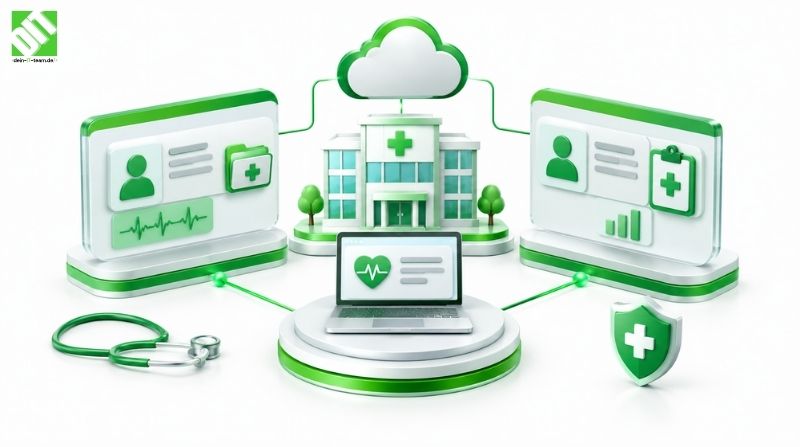
EHR software development explained: the difference between EHR and EMR, core modules, interoperability standards such as HL7 FHIR, and key build decisions.
Introduction
Ask three people in healthcare what an EHR is and you will probably hear three different answers. One will describe the digital chart in their clinic. Another will talk about the hospital-wide system that connects wards, pharmacy and laboratory. A third will use the term EMR for the same thing. The confusion matters, because the two terms describe different scopes, and those scopes lead to very different software requirements, budgets and integration projects.
EHR software development is the work of designing, building and maintaining a system that records patient health information, supports clinical decisions and shares that information safely with other parties. Getting the definition right is the first step, because it determines whether you are building a tool for one practice or a platform that must talk to pharmacies, laboratories, insurers and regional health networks.
This article explains the difference between an electronic health record and an electronic medical record, walks through the core modules a modern system usually contains, and describes the interoperability standards that shape the build. It then covers the decisions that matter most when you start a project, including build, buy or extend, security and privacy, and the process a serious development team should follow. Where a custom healthcare application is the right route, custom software development services can cover the engineering side, but the decisions in this guide should be made first.
Key Takeaways
An EMR (electronic medical record) is the digital chart of a single practice or organisation. An EHR (electronic health record) is broader and is designed to follow the patient across care settings.
Most modern EHR platforms include clinical documentation, orders and results, medication management, scheduling, billing and a patient-facing portal.
Interoperability is the central technical challenge. HL7 FHIR is the most widely adopted standard for exchanging health data through APIs, while HL7 v2 and DICOM remain common in legacy and imaging environments.
Standard vocabularies such as ICD-10, SNOMED CT and LOINC make data meaningful across systems, and they should be designed into the data model from the start.
Security and privacy requirements, including GDPR obligations for health data in Europe and HIPAA in the United States, shape architecture as much as features do.
Build, buy or extend is the first real decision. Many organisations reach a better result by extending an existing platform than by building a full EHR from scratch.
EHR and EMR: What the Terms Actually Mean
The two terms are often used loosely, but the distinction is useful when you define requirements.
Electronic Medical Record (EMR)
An EMR is the digital version of the chart that a single provider keeps for its patients. A general practice, a dental clinic or a specialist centre might use an EMR to record diagnoses, prescriptions, consultation notes, test requests and billing. The record is primarily designed for that organisation’s own use. It supports the clinical work of the people inside the practice, and it may not share data easily with outside providers.
EMRs are often simpler systems. They focus on documentation and workflow within one setting, and their integration needs are usually limited to a laboratory, a billing service or a few partner systems.
Electronic Health Record (EHR)
An EHR is a broader concept. It is intended to hold a longitudinal view of a patient’s health across multiple providers, departments and settings. A patient might see a GP, a cardiologist, a physiotherapist and a hospital, and an EHR aims to bring the relevant information from each of those encounters together. The record is designed to be shared, with appropriate consent and access controls.
Because of that scope, EHRs must support far more integration, far stricter access control and far more careful data governance. They also need to handle data that originates in many different systems, formats and quality levels.
The table below summarises the practical differences for a development project.
| Aspect | EMR | EHR |
| Primary scope | One practice or organisation | Care across multiple providers and settings |
| Data sharing | Limited, usually by request | Designed to share with authorised parties |
| Typical users | Clinicians and staff within one site | Clinicians, departments, patients and external partners |
| Integration needs | Laboratory, billing, a few partners | Laboratories, pharmacies, imaging, regional networks, payers |
| Interoperability emphasis | Moderate | High, based on standards |
| Access control complexity | Organisation-level roles | Granular, consent-aware, cross-organisation |
| Typical build scope | Focused clinical and administrative workflows | Broader platform with APIs, analytics and patient access |
In practice, many products sold as EHRs are configured as EMRs in smaller settings, and the terms are used interchangeably in marketing. For a development brief, what matters is the scope of data sharing and the number of systems the product must connect to. Write those requirements down, and the label becomes less important.
Core Modules in an EHR
An EHR is not a single screen. It is a set of modules that share a common patient record. The exact list depends on the care setting, but most serious systems include the following.
Clinical documentation. Structured notes, problem lists, allergies, past medical history and encounter templates. Clinicians need to document quickly, and the design of these forms has a direct effect on whether the system is used well or worked around.
Orders and results. Requests for laboratory tests, imaging and referrals, along with the returned results. This module must handle status tracking, result acknowledgement and alerts for abnormal values. Missed results are one of the most serious safety risks in outpatient care, so the workflow design deserves close attention.
Medication management. Prescribing, medication reconciliation, drug interaction checks and dispensing records. This module usually depends on licensed drug databases and must respect local regulations on prescribing.
Scheduling and administration. Appointment booking, patient registration, referral tracking and resource planning for rooms and equipment. These functions look simple but often generate the most day-to-day complaints from staff if they are poorly designed.
Billing and claims. Coding, invoicing, insurance claims and payment reconciliation. The rules differ significantly between countries and between insurance systems, so this module is rarely transferable without adaptation.
Patient portal. Secure access for patients to view results, request appointments, send messages and complete forms before a visit. Portal design involves authentication, consent management and accessibility requirements, and it often needs to work on mobile devices.
Analytics and reporting. Quality measures, population health views, operational dashboards and regulatory reporting. Good analytics depend on consistent coding and clean data, which is why terminology decisions made early pay off later.
A practical way to scope an EHR build is to decide which modules must exist at launch and which can follow. A small clinic may need documentation, scheduling, prescribing and billing before it needs analytics. A hospital group may need all of them, plus the integration layer that connects them to regional systems.
Interoperability Standards You Cannot Ignore
Interoperability is the ability of different systems to exchange information and use it correctly. In healthcare it is not optional. A hospital that cannot send discharge letters to a GP, or a laboratory that cannot return results in a usable format, creates clinical risk and administrative burden.
Several standards shape EHR development.
HL7 v2
Health Level Seven version 2 is a messaging standard that has been used for decades, particularly for admissions, discharges, transfers and lab results between hospital systems. It remains common in legacy environments. Its messages are pipe-delimited and can be inconsistent across vendors, so integration work often involves mapping and testing each interface carefully.
HL7 FHIR
Fast Healthcare Interoperability Resources, usually written as FHIR, is the newer HL7 standard. It defines health data as resources such as Patient, Observation, Medication and Encounter, and exposes them through RESTful APIs. FHIR is designed for web and mobile development patterns, which makes it a natural fit for patient portals, third-party apps and modern integration layers.
When planning a new EHR, FHIR should usually be the default for external interfaces, although it does not remove the need to understand HL7 v2 feeds from existing systems. Many projects run both: FHIR APIs for new integrations and a messaging layer for legacy connections.
Terminologies: ICD-10, SNOMED CT and LOINC
Messages carry codes, and the codes must mean the same thing across systems. ICD-10 is widely used for diagnoses and billing. SNOMED CT provides a much more granular clinical vocabulary for findings, procedures and conditions. LOINC codes identify laboratory tests and observations. Choosing and mapping these vocabularies is a significant task, and it should be planned as part of the data model rather than added at the end.
DICOM
Digital Imaging and Communications in Medicine governs medical imaging. If the EHR must display or link to radiology images, it will need to connect to a picture archiving and communication system (PACS) and handle DICOM objects. Many organisations keep imaging in a dedicated system and integrate by reference rather than storing images within the EHR itself.
The practical lesson is that interoperability is a design decision, not a feature. A system that treats standards as an afterthought will struggle to connect to laboratories, pharmacies or regional exchanges later, and retrofitting those connections is expensive.
What to Build: Build, Buy or Extend
Before writing any code, decide which of three routes fits your situation.
Buy. Adopt a commercial EHR or EMR product that already covers most of your needs. This is often the fastest and least risky route for a standard clinical setting. The trade-offs are licence fees, dependence on the vendor’s roadmap and limited ability to tailor workflows.
Extend. Keep a core system and build additional applications around it. This might mean a custom patient portal, a specialist module, a data analytics layer or integration middleware that connects an existing EHR to other systems. Extension is frequently the best value when the core system works but leaves specific gaps.
Build. Create a new system from the ground up. This gives full control over data models, workflows and architecture, but it requires substantial investment in clinical input, regulatory knowledge, security engineering and long-term maintenance. Building a full EHR is a major programme, and most organisations should only choose it when their requirements are genuinely unmet by available products.
A useful test is to write down the three workflows that matter most to your clinicians or patients. If an existing product handles them well and only a few areas need adjustment, extending is usually sensible. If the core workflow is unusual, or the regulatory and data requirements are specific to your setting, building becomes more justified.
Custom work often sits between these routes. A development partner may build a specialist module that exchanges data with an existing EHR through FHIR APIs, rather than replacing the entire record. This approach limits risk and lets clinicians keep familiar tools while the organisation adds capabilities that were missing.
Build Considerations That Shape the Project
Once the route is chosen, several technical and human factors determine whether the system succeeds.
Security and Privacy
Health data is among the most sensitive categories of personal information. Under the GDPR it is a special category of data that requires a specific legal basis and stronger safeguards. In the United States, HIPAA sets rules for protected health information. Whichever framework applies, the architecture needs role-based access control, encryption in transit and at rest, detailed audit logging, secure authentication (including multi-factor options for clinical users), and a clear process for incident response.
Security should be designed into the data model and the APIs from the start. Retrofitting access control into a system that was built without it is one of the most costly mistakes in healthcare software.
Usability for Clinicians
Clinicians work under time pressure, and poorly designed systems slow them down, increase error rates and cause frustration that spreads through an organisation. Usability research with real users should happen early, using realistic scenarios such as a busy morning clinic or an emergency handover. Interface decisions about navigation, templates and alerts should be tested against those scenarios rather than assumed.
Alert design deserves particular care. Systems that generate too many warnings train users to ignore them, which can be dangerous. Alerts should be specific, actionable and tuned with clinical input.
Architecture and Integration
A healthcare platform usually benefits from a layered architecture. The core clinical data store sits at the centre, with an API layer exposing standard resources to internal modules and external partners. Integration services handle message translation, terminology mapping and queueing so that a slow external system does not block clinical work.
This is where API development and integration becomes central. A well-designed API layer lets the EHR exchange data with laboratories, pharmacies, device providers and third-party applications without each connection being built as a one-off. It also makes the system easier to test and to extend as standards and partners change.
Scalability matters too, particularly for regional deployments or systems that handle peak loads during the day. Cloud hosting can help, but the choice of hosting must respect data residency rules and the provider’s compliance commitments.
Data Quality and Migration
Moving existing records into a new system is often the most underestimated task in an EHR project. Historical data may use inconsistent codes, free-text entries where structured data is needed, duplicate patient records and formats that have changed over time. A migration plan should include data profiling, mapping rules, clinical sign-off on the mapped content and a reconciliation process after go-live.
Clinical safety depends on data quality. A patient record that merges two individuals, or a medication list that drops an allergy, is not a minor technical defect. It is a patient safety issue.
Phasing the Work
Healthcare organisations rarely replace everything at once, and a phased approach usually reduces risk. A practical sequence might begin with a core clinical module and patient registration, followed by integrations with laboratories and pharmacies, then the patient portal, and finally analytics and reporting. Each phase should deliver working value and be tested with real users before the next one starts.
Where a related project is already underway or being planned, it helps to understand the wider picture. Our article on healthcare app development, including features, cost and timeline explores how those decisions play out in practice and how to estimate the scope of a healthcare application before committing to a build.
A Development Process for EHR Projects
A sound EHR project follows a lifecycle that gives clinical, technical and regulatory stakeholders a real voice at each stage.
Discovery and clinical requirements. Map the workflows that matter most, identify the users and their constraints, and document regulatory obligations. Clinical staff should be involved from this point onwards, not only at the testing stage.
Architecture and standards planning. Decide on the data model, the terminologies, the interoperability approach (FHIR, HL7 v2, or both), the hosting strategy and the security architecture.
Prototyping and usability testing. Build clickable prototypes of key workflows and test them with clinicians and administrative staff. Revise before writing production code.
Development and integration. Build modules incrementally, with integration work running in parallel. Integration testing against realistic message samples and sandbox environments from partners should be continuous.
Testing, validation and safety review. Cover functional testing, performance under realistic load, security testing and penetration testing. Clinical safety review should check how the system behaves when data is missing, delayed or inconsistent.
Data migration and training. Run trial migrations, reconcile results with clinical staff, and train users on realistic scenarios rather than generic demonstrations.
Go-live and monitoring. Use a controlled rollout, with support available on site or on call. Monitor interface errors, response times and user-reported problems closely in the first weeks.
Maintenance and continuous improvement. Standards, regulations and partner systems change. Planning for regular updates, version management and periodic security reviews is part of the cost of ownership.
Cost and Timeline Drivers
The cost of an EHR project varies widely, and any single figure should be treated with caution. Actual cost depends on scope, the number of modules, the number and complexity of integrations, regulatory requirements, the level of clinical customisation, data migration volume, hosting arrangements and the team composition. Projects that connect to many external systems, or that must satisfy several national regulatory regimes, typically take longer and cost more than a single-site clinical system.
Timelines follow a similar pattern. A focused module extending an existing platform may be delivered within a few months. A full EHR for a regional network is usually a multi-year programme delivered in phases. Schedules are often driven less by development speed than by approvals, clinical validation, interface testing with external partners and the availability of clinical staff for testing.
When comparing proposals, ask for an explicit breakdown of discovery, integration, security, migration, training and ongoing support. Proposals that leave these out tend to produce surprises later.
Common Challenges
Several challenges recur across healthcare software projects.
The first is unclear ownership of clinical decisions. Developers should not be deciding alert thresholds or documentation templates alone. A named clinical lead with authority over those decisions prevents costly rework.
The second is partner dependency. Integrations depend on the availability and stability of external systems, many of which have their own release cycles. Maintaining test environments and monitoring interface health is essential.
The third is change fatigue among users. Replacing a familiar system is disruptive, and even well-designed improvements can meet resistance. Involving users early, explaining the reasons for change and providing practical training helps adoption.
The fourth is standards drift. Implementations of HL7 and FHIR can differ between vendors, and profiles may vary by country. Testing against real partner systems, rather than relying only on the specification, reduces integration failures.
When to Work with a Development Partner
Some healthcare organisations have strong internal technical teams that can lead an EHR project with occasional external support. Others need a partner who can bring engineering capacity, integration experience and security discipline to a programme that is larger than their current team can handle. A partner is particularly useful when the project spans several systems, needs custom APIs, must meet formal compliance requirements or requires a long-term support model.
DEIN IT TEAM is the European partner brand of Cyberinfrastructure India (CIS). Projects combine local project management in Europe with engineering capacity delivered through CIS, which allows one team to support healthcare software work from requirements through build, integration and ongoing maintenance. Whether that model fits a particular organisation depends on its scope, internal capabilities, regulatory environment and preferred way of working.
When you speak with any potential partner, ask how they handle clinical input, which interoperability standards they have implemented, how they approach security and audit logging, and how they plan data migration. Clear answers to those questions say more than a list of features.
Conclusion
EHR software development starts with a clear understanding of what the system must do. An EMR serves one organisation’s clinical work, while an EHR is designed to carry a patient’s record across providers and settings. That difference drives the scope of modules, the depth of interoperability and the rigour of security and governance. Standards such as HL7 FHIR, along with shared vocabularies like SNOMED CT, ICD-10 and LOINC, determine whether the system can exchange data safely with the rest of the healthcare ecosystem.
Your most useful next step is to write down the workflows that matter most, list every system the software must connect to, and identify which regulatory frameworks apply. With those answers, you can decide whether to buy, extend or build, and you can compare proposals on the same basis. If you are ready to discuss your requirements, you can talk through your project with DEIN IT TEAM, including how cloud integration services might support secure hosting and data exchange for your healthcare platform.
Frequently Asked Questions
What is the difference between EHR and EMR?
An EMR is the digital chart kept by a single practice or organisation for its own clinical and administrative use. An EHR is broader and is designed to hold a patient’s health information across multiple providers and care settings, with appropriate consent and access controls. In practice the terms are often used interchangeably, so the most useful distinction is the scope of data sharing a system must support.
What modules does an EHR system usually include?
Most EHR systems include clinical documentation, orders and results, medication management, scheduling and administration, billing and claims, a patient portal, and analytics or reporting. The modules needed at launch depend on the care setting. A small clinic may start with documentation, scheduling, prescribing and billing, while a larger organisation needs a broader set plus an integration layer.
What is HL7 FHIR and why does it matter for EHR development?
HL7 FHIR is a standard that represents health data as resources, such as patients, observations and medications, and exposes them through web-based APIs. It matters because it makes it easier to connect EHRs with patient apps, laboratories, pharmacies and other partners using modern development methods. Many projects also need to support HL7 v2 messages from older systems, so both standards often coexist.
How much does EHR software development cost?
Cost depends on scope, the number of modules, the number and complexity of integrations, regulatory requirements, data migration volume, hosting arrangements and the team involved. A focused module that extends an existing platform costs far less than a full EHR for a regional network. Any figure should be checked against a detailed scope, and proposals should show discovery, integration, security, migration, training and support separately.
How long does it take to build an EHR?
A focused module or extension can be delivered within a few months. A full EHR for a group of providers is typically a multi-year programme delivered in phases. The timeline is often driven by clinical validation, approvals, interface testing with partner systems and the availability of clinical staff for user testing, rather than by coding speed alone.
Should a healthcare organisation buy an EHR or build its own?
Most organisations should first check whether an existing product meets their core workflows. Buying is usually fastest and lowest risk for standard settings. Extending a core system with custom modules or integration layers suits organisations with specific gaps. Building a full EHR is justified mainly when available products genuinely cannot meet the clinical, regulatory or data requirements.
How is patient data kept secure in an EHR?
Secure EHR systems combine role-based access control, encryption in transit and at rest, strong authentication, detailed audit logging, regular security testing and a documented incident response process. Requirements such as GDPR in Europe or HIPAA in the United States also shape data residency, consent management and breach reporting obligations. Security should be designed into the architecture from the start rather than added later.
Can an EHR connect to laboratories, pharmacies and imaging systems?
Yes, provided those systems support a suitable interface. Laboratories and hospitals often exchange data using HL7 v2 messages or FHIR APIs. Imaging typically uses DICOM and a picture archiving and communication system, with the EHR linking to the images rather than storing them. Integration work requires testing against real partner systems, because implementations can differ even when they follow the same standard.