

AI Agents vs AI Assistants: What's the Difference?
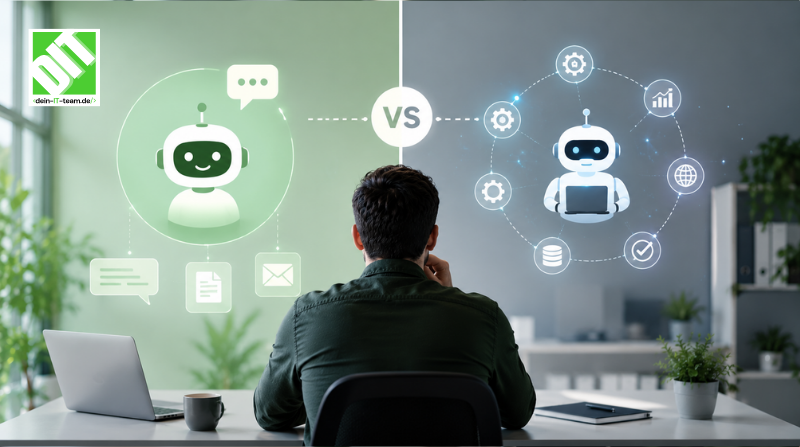
Understand the difference between AI agents and AI assistants. Learn when to use each, real-world examples, and how to choose for your business.
The terms "AI agents" and "AI assistants" are increasingly used interchangeably, but they represent fundamentally different approaches to automation and problem-solving. Understanding the distinction isn't just academic; it directly impacts how you choose to implement AI in your business.
If you're evaluating AI solutions for customer service, data analysis, or workflow automation, you need to know whether you're looking at an agent or an assistant. The wrong choice can lead to over-engineered systems or tools that don't meet your actual needs.
This guide breaks down exactly what makes them different, where each excels, and how to decide which approach fits your business.
Key Takeaways
AI assistants are reactive responders that answer questions and follow explicit instructions, while AI agents are proactive decision-makers that pursue goals independently.
Assistants work best for customer support and information retrieval; agents excel at complex, multi-step business processes.
Agents require more sophisticated architecture, including APIs and decision frameworks, making them better suited for enterprise environments.
The choice between agent and assistant depends on your workflow complexity, autonomy requirements, and technical infrastructure.
AI solutions benefit significantly from structured cloud infrastructure and well-designed APIs to function effectively at scale.
Many modern implementations use hybrid models that combine assistant responsiveness with agent autonomy for optimal results.
AI Assistants: Reactive Problem-Solvers
What They Are
An AI assistant is a tool designed to respond to user input. It processes questions, requests, or commands and delivers answers or performs specific actions based on those inputs. Think of it as a highly trained employee who waits for direction before taking action.
Assistants are deterministic in nature: if you ask the same question, you'll get consistent responses. They follow predefined rules, trained patterns, or retrieval-based systems to generate answers. They don't pursue goals independently or decide to take action without being prompted.
How Assistants Work
Assistants operate on a straightforward request-response model:
User sends a query or command
The assistant processes the input
The assistant retrieves information or executes a programmed action
Response is delivered to the user
They can be powered by large language models, knowledge bases, or rule-based systems. The key is that the assistant waits for a trigger and then responds; it doesn't anticipate future actions or manage complex workflows independently.
Best Use Cases
Customer support chatbots, FAQ automation, document summarization, email drafting assistance, research helpers, and real-time translation tools are all classic assistant applications. If the task involves answering questions or executing simple commands, an assistant is typically the right choice.
Limitations
Assistants struggle with multi-step processes that require judgment between steps, long-term goal pursuit, or adaptive decision-making. They can't handle ambiguous situations well without explicit guidance, and they're not suited for complex business logic that depends on context and previous outcomes.
AI Agents: Autonomous Problem-Solvers
What They Are
An AI agent is an autonomous system designed to achieve specific goals. Unlike assistants, agents don't wait for instructions at every step. They perceive their environment (or the data available to them), make decisions based on that context, and take action toward predefined objectives.
Agents operate with a degree of autonomy. They can break down complex problems into smaller tasks, execute those tasks, evaluate results, and adjust their approach if needed. They're goal-oriented and action-oriented.
How Agents Work
Agents follow a perception-decision-action loop:
Agent perceives current state (data, environment, previous results)
The agent analyzes the situation and determines the next steps
Agent executes action (which may involve APIs, tool calls, or database queries)
Agent evaluates outcome and adjusts strategy if needed
The cycle repeats until the goal is achieved
This is fundamentally different from assistants because agents maintain state, pursue objectives over multiple steps, and adapt based on feedback. They're designed to handle complexity and autonomy.
Best Use Cases
Workflow automation, data analysis pipelines, autonomous customer onboarding, supply chain optimization, financial forecasting, and IT operations management are where agents shine. Any process that's too complex or variable for rigid rules benefits from an agent architecture.
Capabilities and Constraints
Agents can handle nuanced decision-making, long-running processes, and systems that require ongoing adaptation. However, they also require more sophisticated infrastructure, clearer goal definition, and robust monitoring. They're harder to debug and may produce unexpected outcomes if not carefully designed.
Head-to-Head: Assistants vs Agents
| Aspect | Assistants | Agents |
| Autonomy | Reactive; waits for user input | Proactive; pursues goals independently |
| Decision-Making | Follows rules or trained patterns | Adapts decisions based on outcomes |
| Complexity | Best for straightforward tasks | Handles multi-step, complex processes |
| Speed to Value | Quick implementation | Longer setup and refinement time |
| Infrastructure | Lighter requirements | Needs APIs, monitoring, and decision frameworks |
| Cost | Lower implementation and maintenance | Higher due to complexity |
| Predictability | High, consistent responses | Requires safety guardrails and testing |
| Best For | Q&A, support, simple automation | Business intelligence, complex workflows |
When to Choose an Assistant
Choose an assistant if your use case involves answering questions, providing information, or executing well-defined, single-step actions. Assistants are ideal when you need quick deployment, lower complexity, and straightforward user interactions.
Customer support automation, knowledge base retrieval, and content summarization are classic assistant territory. If your team is just starting with AI automation and wants to build confidence, assistants are a practical entry point.
When to Choose an Agent
Choose an agent when you need to automate complex business processes, analyze data across multiple systems, or enable autonomous decision-making. Agents make sense when the alternative is hiring skilled professionals to manage routine decision-making.
If your process involves conditional logic, multiple tool integrations, or adaptive responses based on outcomes, you're looking at an agent problem. They're worth the investment for processes that scale or run continuously.
Real-World Comparison
A customer service assistant handles incoming support tickets by retrieving relevant documentation and drafting responses. A human operator still reviews and sends these responses.
An autonomous agent manages the entire customer lifecycle: it receives a new lead, routes them to the appropriate department, schedules follow-ups, tracks engagement, and escalates based on predefined triggers all without human intervention at each step.
Both are valuable, but they solve different problems.
Building Effective AI Solutions
The technical foundation matters. Both assistants and agents rely on well-designed systems to function reliably.
For assistants, you need solid data infrastructure and clear knowledge bases. For agents, you need more: robust API connectivity to external systems, cloud deployment frameworks, and sophisticated monitoring.
An artificial intelligence development company that understands your specific industry can help you evaluate which approach fits your strategy. They should guide you toward the architecture that balances your business needs with technical feasibility.
API development services are essential if you're building agents. Agents need to connect with your existing systems, databases, and third-party tools. Clean, well-designed APIs make this possible. Without them, you're building rigid, isolated systems.
Similarly, cloud integration services matter for deployment and scaling. AI solutions, whether assistants or agents, perform best when deployed on a modern cloud infrastructure that supports monitoring, version control, and seamless integration with your business systems.
Hybrid Approaches
In practice, many organizations build systems that combine both patterns. You might use an assistant for customer-facing interactions, but back it with an agent that handles internal complexity. This hybrid approach often delivers the best balance between user experience and operational efficiency.
For deeper context on how these technologies fit into broader business transformation, consider reviewing our guide on AI Integration in Business, which covers adoption strategies and common obstacles teams face.
Conclusion
AI assistants and AI agents address different problems, and the best choice depends on your specific workflow and goals. Assistants excel at responsiveness and simplicity; agents excel at autonomy and complexity. Neither is universally "better"; context determines the winner.
The key is honest assessment: Does your process need to wait for human direction at each step, or should it run autonomously toward a goal? Does it involve simple lookups or complex, multi-stage decisions? Your answer points you toward the right approach.
Start with clear business requirements, consult with experienced AI partners, and build infrastructure that can evolve as your needs grow.
Frequently Asked Questions (FAQs)
Can an AI assistant become an AI agent?
Not directly, but you can evolve a system from assistant-like behavior to agent-like behavior by adding decision-making layers, feedback loops, and goal pursuit architecture. It's usually a redesign rather than an upgrade.
Do agents always produce better results than assistants?
No. Agents are better at complex, autonomous tasks. Assistants are better at simple, focused interactions. Overkill architecture wastes resources and introduces unnecessary failure points.
How much technical expertise do I need to implement agents?
Significant expertise. You need strong backend engineering, API design, data architecture, and DevOps skills. Most organizations partner with external developers for agent implementation.
Recent Posts
October 12, 2026
September 30, 2026
October 13, 2026