

Software Development Methodology: Choosing the Right Approach
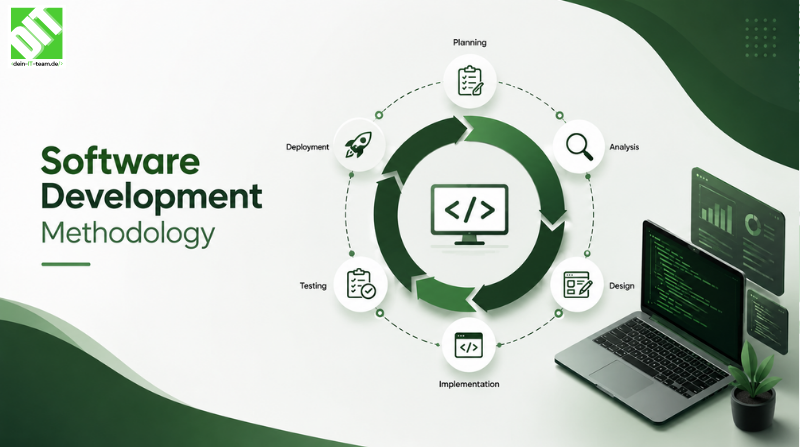
Learn how to choose the right software development methodology, including Agile, Waterfall, and Hybrid approaches for successful projects
Your software development methodology determines how work flows, how quickly you deliver, how well you adapt to change, and ultimately whether your project succeeds or fails.
Yet most organizations choose their software development methodology by accident. They inherit whatever approach their first developer used. Or they copy what another company does. Or they pick based on buzzwords without understanding whether that approach actually fits their situation.
This haphazard approach costs real money. The wrong software development process wastes weeks in unnecessary meetings. It delays delivery because the methodology doesn't match the project. It frustrates teams because processes feel heavy or undefined. It creates risk because feedback loops don't exist.
The organizations shipping software faster, with happier teams, and more predictable outcomes aren't necessarily smarter. They're simply intentional about which development approach they use and why.
This guide walks you through the landscape of software development methodologies, explains what each one actually means, helps you evaluate which fits your situation, and shows you how to implement it effectively.
Key Takeaways
Software development methodology directly impacts delivery speed, team satisfaction, and project predictability by structuring how work flows, communication happens, and feedback is gathered.
No single methodology is best for all situations - the right approach depends on project complexity, team experience, uncertainty, and organizational culture.
Agile development methodology has become dominant but works best for complex, evolving requirements. Waterfall still makes sense for well-defined, stable projects.
Most modern organizations use hybrid approaches combining elements of multiple methodologies to fit their specific context.
Implementation matters more than the methodology itself - a well-executed imperfect approach beats a perfectly-designed process executed poorly.
Choosing the wrong development approach selection can delay delivery by 40-60% and increase costs by similar margins.
What Is Software Development Methodology?
A software development methodology is a structured framework for how work gets organized, planned, executed, and delivered.
It answers critical questions: How do you know what to build? How do you prioritize work? How do you manage changes and risks? How often do you release? When and how do you gather feedback? How do you handle problems that surface during development?
Different methodologies answer these questions differently, creating fundamentally different ways of working.
Think of methodology as the blueprint for how your development team operates. Some blueprints emphasize detailed upfront planning. Some emphasize responding to change. Some emphasize individual heroics. Some emphasize process discipline. The blueprint you choose shapes everything downstream.
The Major Software Development Methodologies Explained
There are dozens of methodologies in use. But most fall into a few core categories, each representing a different philosophy about how software should be built.
Waterfall: Sequential, Plan-Driven Development
Waterfall is the traditional approach. Work flows sequentially through distinct phases: requirements, design, development, testing, deployment. Each phase is completed before the next begins.
How it works: Requirements are gathered exhaustively upfront. Design is completed before coding starts. Coding is completed before testing begins. Testing happens before release. Each phase has gates and sign-offs.
Strengths:
Excellent for well-defined requirements where you know exactly what you're building
Clear timeline and budget predictability
Extensive documentation helps with compliance and maintenance
Straightforward project planning and resource allocation
Works well for hardware-constrained projects where changes are expensive
Limitations:
Requires that requirements be known upfront and stable
Feedback comes late (testing phase), after significant work is done
Changes are expensive because you've already moved past the impacted phases
Risk (whether the final product is right) isn't known until late in the project
Teams can become siloed (requirements team hands off to design, design hands off to development)
When to use it: Regulated industries with stable requirements, fixed-price contracts requiring upfront definition, large teams in different locations where coordination is complex.
Agile: Iterative, Feedback-Driven Development
Agile flips the script. Instead of comprehensive upfront planning, work happens in short cycles (sprints, typically 1-2 weeks) with continuous feedback and frequent delivery.
How it works: Product vision is defined but detailed requirements emerge over time. Development cycles repeat: plan work, execute, gather feedback, adjust. Regular releases (weekly, bi-weekly, or monthly) put working software in front of users.
Strengths:
Excellent for complex projects where requirements aren't fully known upfront
Feedback comes early and often, reducing risk of building the wrong thing
Changes are absorbed naturally as part of the process
Frequent delivery means value reaches users quickly
Teams stay focused and motivated by seeing progress
Works well for uncertain environments where priorities shift
Limitations:
Requires significant customer/stakeholder involvement throughout
Harder to predict final timeline or cost (you're building toward a vision, not a fixed requirement)
Can lack discipline if not well-executed (meetings become endless, scope creeps)
Documentation often suffers (working software is prioritized over documentation)
Scaling agile to large teams is complex
When to use it: Innovative products with evolving requirements, rapid market response needed, complex problems without clear solutions, environments where customer feedback drives the product.
Lean: Efficiency-Focused Development
Lean emphasizes eliminating waste, delivering value efficiently, and respecting people. It evolved from lean manufacturing principles applied to software.
How it works: Identify what creates value for customers. Eliminate anything that doesn't. Optimize workflows to reduce delays, handoffs, and rework. Empower teams to make decisions.
Strengths:
Highly efficient, minimal wasted effort
Focuses teams on what actually matters to customers
Encourages continuous improvement
Respects team autonomy and expertise
Great for optimizing existing processes
Limitations:
Requires deep understanding of what creates customer value
Can be harsh if not balanced with humanity
Doesn't inherently provide structure for inexperienced teams
Works best as a mindset, not just a process
When to use it: Optimizing existing processes, cost-sensitive environments, organizations that can identify value clearly.
DevOps: Operational Mindset Merged with Development
DevOps blurs the line between development and operations. Instead of development building and operations running software, the mindset emphasizes shared responsibility, automation, and continuous improvement.
How it works: Development and operations collaborate throughout. Infrastructure is automated. Deployment is automated. Monitoring is built-in. Feedback loops are tight. The goal is rapid, reliable delivery with minimal manual work.
Strengths:
Enables rapid, safe deployment
High quality because issues are caught and fixed quickly
Reduces hand-offs and delays between development and operations
Great for cloud-based applications
Enables small teams to do big things
Limitations:
Requires investment in automation infrastructure
Demands cultural shift from traditional development-operations separation
Can be overkill for simple applications
Requires sophisticated tooling
When to use it: Cloud-native applications, continuous delivery requirements, organizations scaling rapidly.
Hybrid Approaches: Mixing and Matching
Most modern organizations don't use pure methodologies. They blend them.
For example: Using agile development methodology for the core product development (sprints, frequent releases) while maintaining waterfall-style planning for infrastructure changes. Or using DevOps practices for deployment while maintaining structured requirements gathering. Or combining Lean principles for efficiency with Agile frameworks for delivery cadence.
Hybrid isn't wishy-washy. It's intentional combination of practices that fit your specific situation.
Understanding Software Development Process Frameworks
Beyond methodologies, there are specific frameworks that implement methodologies. Think of frameworks as detailed recipes for methodologies.
Scrum (Agile Framework)
Scrum is the most widely-adopted agile development process framework. It provides specific roles (product owner, scrum master, development team), ceremonies (daily standup, sprint planning, retrospective), and artifacts (product backlog, sprint backlog, burndown charts).
Scrum works well for teams that need structure while remaining responsive. It's particularly good for mid-size teams (5-10 people) working on complex products.
Kanban (Agile/Lean Framework)
Kanban visualizes work as it flows through stages (to-do, in-progress, done). Work is pulled, not pushed. Limits are placed on work-in-progress to prevent overload.
Kanban works well for teams with continuous or unpredictable work (support teams, operations, maintenance), or teams that have tried Scrum and found it too ceremonial.
XP (Extreme Programming)
XP emphasizes technical excellence through practices like pair programming, test-driven development, continuous integration, and simple design.
XP works well for teams where code quality is critical and technical risk is high.
SAFe (Scaled Agile Framework)
SAFe applies agile concepts to large organizations, providing structure for multiple teams working toward common goals.
SAFe works for enterprises scaling agile across many teams and departments.
How to Choose Your Development Approach: The Decision Framework
Choosing the right software development process means understanding your specific context.
Assess Your Project Characteristics
Start by understanding what you're building:
Requirements clarity: How well-defined are your requirements? If you know exactly what you need and requirements are stable, traditional approaches work. If requirements are fuzzy, evolving, or discovered through building, agile approaches fit better.
Complexity: Is this a simple project or complex? Simple projects might not warrant sophisticated processes. Complex projects need structure to manage that complexity.
Uncertainty: How much do you know about the solution? Familiar problems suit traditional approaches. Novel problems suit agile approaches where you learn as you build.
Change likelihood: Will requirements change? If yes, plan for it. Agile handles change well. Waterfall doesn't.
Regulatory constraints: Are there compliance requirements? Some regulations favor extensive documentation (waterfall). Some are agnostic to process (focus on outcomes, not how you get there).
Assess Your Organization
Beyond the project, understand your team and organizational context:
Team experience: Agile requires experienced, self-organizing teams. Less experienced teams sometimes benefit from more structure. Team experience matters more than the methodology.
Team size: Scrum works well for single teams (5-10 people). Larger initiatives need frameworks for scaling (SAFe, LeSS). Small teams might need minimal process.
Distributed vs. co-located: Co-located teams can use ceremonies that distributed teams struggle with. Distributed teams often benefit from asynchronous communication approaches.
Organizational culture: Hierarchical organizations resist agile. Flat organizations sometimes struggle with waterfall structure. Choose approaches that fit your culture or be willing to change culture.
Customer availability: Agile requires frequent customer/stakeholder interaction. If stakeholders are unavailable, agile feedback loops break down.
Timeline urgency: Need something in 6 weeks? Agile gets to value faster. Have 18 months? Waterfall might allow for more upfront planning.
Decision Matrix
Your choice typically falls into these scenarios:
Scenario A: Well-defined requirements, stable, regulated environment, large team, fixed timeline/budget
Best fit: Waterfall or structured hybrid
Scenario B: Evolving requirements, innovative product, small team, rapid delivery needed
Best fit: Agile (Scrum or Kanban)
Scenario C: Continuous operations, unpredictable work, support/maintenance focus
Best fit: Kanban
Scenario D: Large organization, multiple teams, need to scale agile
Best fit: SAFe or LeSS
Scenario E: Technical excellence critical, code quality at risk, complex engineering
Best fit: XP combined with agile
Scenario F: Cloud-native, need rapid deployment, continuous delivery required
Best fit: DevOps mindset combined with agile
Most real situations are Scenario E or F: hybrid approaches combining elements of multiple methodologies.
The Role of Software Development Process in Success
Your software development methodology isn't just process bureaucracy. It fundamentally shapes outcomes.
The right methodology accelerates delivery. Agile approaches get working software in front of users quickly, allowing rapid feedback and course correction. For complex products where you're learning what customers actually want, this matters enormously. You can make smart decisions based on real feedback instead of guesses made in requirements documents.
The right methodology reduces risk. When you identify problems early and often, you can address them while they're small. Waterfall delays feedback until testing phase, when problems are expensive to fix. Agile's early, frequent feedback surfaces problems early.
The right methodology attracts and retains talent. Developers want to work in environments with clear process, supportive teams, and ability to see impact. Both well-executed agile and well-executed waterfall environments provide this. Poorly-executed either is soul-crushing.
The right methodology enables better planning and estimation. Agile's iterative approach with frequent retrospectives and velocity tracking provides increasingly accurate estimates. Waterfall's upfront planning can work but only when requirements are truly stable and team composition is stable.
Implementing Your Chosen Development Approach
Choosing a methodology is step one. Implementing it well is what actually matters.
Phase 1: Clarify Fundamentals
Before changing processes, be clear about:
What problems are you trying to solve? (Current process too slow? Unpredictable? Team dissatisfied?)
What outcomes do you want? (Faster delivery? Better quality? Happier team? Better predictability?)
What constraints do you have? (Regulatory requirements, team skills, customer availability, organizational culture)
What's your actual current state? (Many teams think they're doing agile but are doing something else)
Phase 2: Design Your Approach
Based on your context, design your specific software development process. This likely isn't a pure methodology but a hybrid tailored to your situation.
For example:
Core development uses Scrum with 2-week sprints
DevOps practices for deployment automation
Waterfall-style gates for regulatory compliance touchpoints
Kanban for support requests
Document this. Make it explicit.
Phase 3: Train and Establish Practices
Don't just announce the new approach. Train teams. Establish ceremonies and practices. Make it real through consistent execution.
For agile: Daily standups, sprint planning, sprint reviews, retrospectives. Make them valuable, not check-box exercises.
For waterfall: Establish phase gates, requirements sign-offs, design reviews. Make them meaningful, not bureaucratic.
For any approach: Establish how decisions get made, who has authority over what, how feedback flows, how problems surface.
Phase 4: Measure and Refine
Establish metrics aligned with why you changed methodologies. If speed was the problem, measure cycle time. If quality was the problem, measure defect rates. If predictability was the problem, measure estimation accuracy.
Measure monthly for first 3 months, then quarterly. Identify what's working and what's not. Adjust.
Most organizations need 2-3 months to establish a new methodology and 6+ months to truly optimize it. Patience matters.
Real-World Implementation Examples
Example 1: Startup Building an Innovative Product
A fintech startup had a vision for a new lending platform but didn't know exactly what customers wanted. They chose Scrum-based agile with 1-week sprints and weekly demos with customers.
Approach:
Small cross-functional team (4 engineers, 1 designer, 1 product person)
Weekly customer demos to validate assumptions
Bi-weekly releases to production
Ruthless prioritization (build what matters, skip nice-to-haves)
Results:
Discovered early that their original design was wrong (good that they learned this from customers, not six months later)
Pivoted rapidly based on feedback
Launched first version in 3 months instead of planned 6
Built product customers actually wanted because they were building with continuous feedback
This project would have failed under waterfall because the fundamental assumption (what customers wanted) was wrong, and waterfall wouldn't discover this until testing phase.
Example 2: Enterprise Upgrading Core System
A large financial services company was upgrading their core customer management system. Requirements were well-defined by regulation. Changes were expensive. Coordination between business units was complex.
Approach:
Waterfall with phase gates
18-month timeline with clear milestones
Extensive upfront requirements (180-page specification)
Separate requirements, design, development, testing phases
Staged rollout across business units
Results:
Final system delivered on time and budget (unusual for major system implementations)
Regulatory compliance validated during planning phase, not at end
Extensive documentation enabled knowledge transfer
Staged rollout reduced risk
This project succeeded under waterfall because the environment that waterfall handles well was present: stable requirements, regulated industry, large complex organization needing structure.
Example 3: Operations Team Shifting to DevOps
A company with separate development and operations teams was deploying once per quarter. Time from development completing to production deployment was 2-3 months. Operations wanted stability, development wanted speed.
Approach:
Adopted DevOps mindset with shared responsibility
Automated infrastructure provisioning (infrastructure-as-code)
Automated testing and deployment pipeline
On-call rotation where development team also supported production
Deployed weekly then daily as confidence increased
Results:
Time to production dropped from 2-3 months to same day
Incident response improved (team members understood entire stack)
Development team motivated by seeing impact in production
Stability improved because frequent small changes are safer than rare big changes
This transformation wouldn't have worked under traditional waterfall or strict agile without operational discipline. DevOps mindset was essential.
Common Mistakes in Choosing Development Approaches
Mistake 1: Choosing by Fad Instead of Context
Agile is trendy. Organizations adopt it without understanding whether their context suits agile.
Reality: Agile works great for some situations and poorly for others. Choose based on your project and organizational context, not trends.
Mistake 2: Adopting Process Without Cultural Fit
Trying to use waterfall in a culture that values autonomy and experimentation, or agile in a culture that needs structure and predictability.
Reality: Process works when it matches organizational culture. Otherwise, people resist or game the system.
Mistake 3: Implementing Process Without Understanding Why
Adopting agile because "that's what good companies do" without understanding what problems agile actually solves.
Reality: Process is means, not end. If you don't understand what problems you're solving, you can't assess whether the process actually works.
Mistake 4: Confusing Process with Quality
Thinking that following a process ensures quality output.
Reality: Process is necessary but not sufficient for quality. Quality comes from skilled people, clear requirements, and discipline about building right the first time.
Mistake 5: Ignoring the Human Element
Implementing process without considering how it affects people: stress, motivation, learning, collaboration.
Reality: The best process is one that works for your specific team. Adapt based on team feedback.
Mistake 6: Not Measuring Results
Changing methodology but not measuring whether the change actually improved outcomes.
Reality: You can't optimize what you don't measure. Track metrics aligned with why you changed methodology.
Technology's Role in Enabling Your Development Approach
Your choice of development tools should support your chosen methodology.
For agile teams, tools like Jira, Azure DevOps, or Linear provide sprint management, backlog prioritization, and burndown tracking. These tools make agile practices easier to execute.
For teams using DevOps, CI/CD platforms (Jenkins, GitHub Actions, GitLab CI) automate testing and deployment. Infrastructure-as-code tools (Terraform, CloudFormation) enable automation.
For distributed teams, collaboration tools (Slack, Confluence, Figma) enable asynchronous communication that Waterfall's synchronous ceremonies require.
The right tools don't create success but they make success easier. The wrong tools create friction.
For organizations building custom software or needing specialized tools tailored to their development process, custom software development teams can build development support systems (CI/CD pipelines, project management interfaces, testing frameworks) optimized for your specific methodology.
Similarly, as your software development process matures and you need sophisticated automation and monitoring of deployments, DevOps services enable the automation and continuous delivery that modern methodologies require.
Scaling Your Software Development Process as You Grow
As your team and product grow, your development approach must scale too.
Small teams (1-5 people) can be informal. Maybe Kanban with face-to-face communication.
Growing teams (10-20 people) need more structure. Scrum with clear ceremonies works well.
Large teams (20-100+ people) need frameworks for coordination across multiple teams. SAFe, LeSS, or custom frameworks allow multiple teams to work toward shared goals while maintaining autonomy.
Very large organizations (1000+ person engineering) often use multiple approaches. Some teams use strict waterfall for maintenance and compliance work. Some teams use agile for product development. Some use DevOps for infrastructure. A coherent meta-process ties them together.
The key: your development approach scales by adding structure, not by doing the same thing with more people.
Modern Context: Methodology and Methodology Selection in Today's World
The software development landscape has evolved significantly in the past decade.
Cloud infrastructure has made DevOps practices feasible and valuable. Organizations can now deploy multiple times per day safely.
The prevalence of software in every business means development velocity is competitive advantage. Speed matters more than it used to.
The rise of data-driven decision-making means that product decisions should be based on customer behavior data, not guesses in requirements documents. Agile's feedback loops enable this.
The complexity of modern software systems means that detailed upfront design often fails because reality is more complex than anyone predicted. Evolutionary design via agile works better.
Yet waterfall still makes sense for specific contexts: regulated industries, fixed-price contracts, hardware constraints, simple well-understood problems.
The modern reality is that most organizations use hybrid approaches, selecting practices from multiple methodologies to fit their specific context.
Understanding your context and choosing deliberately beats following any pure methodology dogmatically.
How Your Development Methodology Connects to Choosing the Right Partner
Your choice of software development methodology significantly impacts what kind of development partner you should choose.
If you're using agile and iterative development, you need partners who can do frequent communication, weekly or bi-weekly delivery, and responsive feedback incorporation. Waterfall-oriented firms that work on fixed scope won't suit you.
If you're using waterfall with upfront requirements, you need partners who can do detailed requirements gathering, comprehensive planning, and stick to agreements as written. Agile-first firms will frustrate you with their vagueness.
If you're moving to DevOps and continuous delivery, you need technical partners who understand automation, cloud infrastructure, and deployment pipelines.
The development partner you choose should align with your development methodology. To explore how to select the right partner for your specific methodology and business needs, read "How to Choose the Right Software Development Partner for Your Business". It walks through the partnership criteria, evaluation process, and how to ensure alignment between your methodology, team culture, and partner approach.
Measuring Your Development Approach Effectiveness
You can't optimize what you don't measure. Establish metrics that align with why you chose your methodology.
If you chose agile for speed, measure cycle time (how long from idea to customer): Does it match your expectation?
If you chose agile for adaptability, measure how often you successfully change direction based on customer feedback: Are you actually getting intelligence from customers?
If you chose waterfall for predictability, measure estimation accuracy: Do actual projects match the plan?
For any methodology, measure quality (defect rate), team satisfaction, customer satisfaction, and delivery frequency.
For DevOps, measure deployment frequency, lead time, incident rate, and mean time to recovery.
Establish baselines before you change methodology. After change, track metrics monthly for first quarter, then quarterly. Identify what's working. Refine relentlessly.
Most teams see improvement within 2-3 months of implementing a new methodology well. Some see faster improvement. Some take 6+ months if organizational culture resists change.
Conclusion
Your software development methodology shapes your team's rhythm, how you work together, how quickly you deliver, and whether you build the right thing.
There is no universally best approach. The right methodology depends on your project's characteristics, team experience, organizational culture, regulatory environment, and strategic goals.
The agile development methodology works brilliantly for complex, evolving problems with engaged customers. It's terrible for well-defined, stable projects where specification precision matters.
Waterfall works perfectly for regulated industries and fixed-price contracts with stable requirements. It fails spectacularly for innovative products where you're learning what customers actually want.
DevOps works essential for cloud-native applications and continuous delivery. It's overkill for simple systems.
Lean works as efficiency lens across any approach.
The winning organizations don't follow one dogmatic methodology. They understand their context. They choose practices that fit. They implement those practices well. They measure results. They refine continuously.
Start by understanding your actual situation, not what methodology sounds trendy. Design an approach tailored to your context. Implement it with discipline. Measure whether it's working. Adjust based on reality.
Your methodology isn't about following rules. It's about creating structured environment where talented people can build great software efficiently.
Frequently Asked Questions
What is the main difference between agile development methodology and waterfall, and which should I choose?
Waterfall uses sequential phases (requirements, design, development, testing) with extensive upfront planning and limited customer interaction until later stages. Agile uses iterative cycles (sprints) with continuous customer feedback and frequent delivery. Choose waterfall when requirements are stable, well-defined, and unlikely to change (regulated industries, fixed-price contracts). Choose agile when requirements are uncertain, complex, or evolving (innovative products, rapidly changing markets). Most modern organizations use hybrid approaches: agile for core development, waterfall-style gates for compliance.
How long does it take to transition to a new software development process, and what should we expect?
Transitioning to a new methodology typically takes 2-3 months to establish initial practices, 3-6 months to see measurable improvements, and 6-12 months to achieve full optimization. Expect initial productivity dip as teams learn new ways of working. Some resistance is normal as people are creatures of habit. Success depends heavily on leadership commitment, clear communication about why you're changing, adequate training, and patience during transition. Track metrics aligned with your goals to demonstrate progress and maintain organizational support.
Can we use multiple software development methodologies simultaneously within the same organization?
Yes, and most mature organizations do. Different teams might use different methodologies based on their context: product teams using Scrum, support teams using Kanban, infrastructure using DevOps, maintenance using Waterfall. The key is intentionality and clarity. Have a meta-process that coordinates these different teams toward organizational goals. Establish clear communication channels so teams using different methodologies can still collaborate effectively. This requires stronger governance than using a single methodology but allows each team to optimize for their specific context.
Recent Posts


October 14, 2026