How to Build a Dating App: Features, Cost, and Development Process
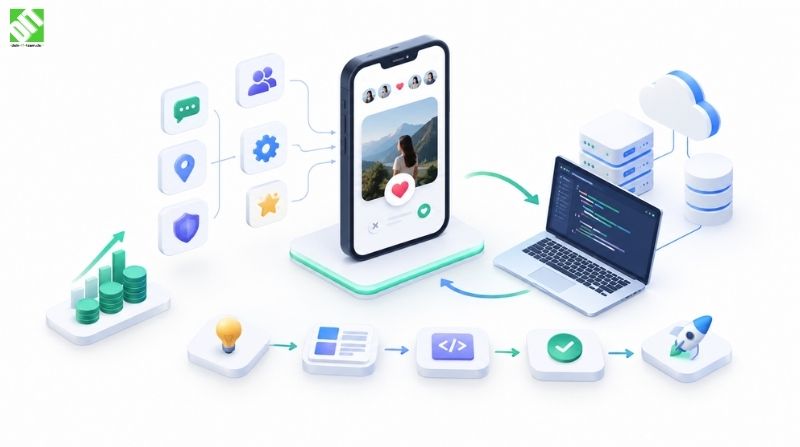
Learn how to build a dating app: must-have features, cost factors, tech stack, development steps, and timelines to launch a safe, scalable product.
To build a dating app, you define a specific audience, design a safe and simple onboarding flow, build core features such as profiles, matching, and chat, add moderation and privacy controls, and then test with a small user group before scaling. A focused MVP typically takes four to seven months. A full-featured platform with AI-based matching and video can take considerably longer.
The harder part is not the code. Dating is a crowded category where users compare you to apps they already know, and they leave quickly when matches feel irrelevant or when safety feels like an afterthought. Most dating apps that struggle fail on product decisions: unclear niche, thin early user base, weak trust features, or a cost model that runs out of money before the network effect arrives.
This guide covers what you need to decide before writing a line of code: app types, essential features, how matching works, the technology involved, realistic cost drivers, timelines, security and compliance, and monetization. It is written for founders, product owners, and businesses exploring the space.
What Is a Dating App and How Does It Work?
A dating app is a mobile or web application that connects people for romantic, social, or relationship-oriented purposes. Users create a profile, state preferences, and are shown other users who fit those preferences. When two people express mutual interest, the app opens a channel for them to communicate.
Behind that simple flow sits a chain of systems:
Registration and verification confirm that a user is real and meets the age requirement.
Profile data (photos, bio, interests, location, preferences) is stored and indexed.
A matching engine filters and ranks candidates for each user.
Interaction mechanics (swipes, likes, prompts, or questionnaires) capture intent.
Messaging starts only after a mutual match, in most designs.
Moderation and safety tools monitor behavior and handle reports.
Every one of these layers has product, engineering, and legal implications, which is why a dating app is closer to a social platform than to a simple utility app.
Types of Dating Apps You Can Build
The type you choose shapes your feature set, your marketing, and your cost. The market has moved away from "one app for everyone" toward clearer positioning.
| Type | How it works | Example direction |
| Swipe-based | Users browse cards and swipe to like or pass | Casual, fast-paced matching |
| Questionnaire or compatibility-based | Users answer detailed questions; the system scores compatibility | Long-term relationship focus |
| Niche or community apps | Built for a specific group, faith, profession, interest, or lifestyle | Smaller audience, higher intent |
| Video-first | Short video profiles or live video dates | Authenticity and reduced catfishing |
| Location-based | Surfaces people nearby in real time | Spontaneous meetups |
| Event or activity-based | Matches people around shared activities or local events | Social discovery |
| Inclusive or LGBTQ+ focused | Designed around identity-specific needs and safety | Dedicated community |
If you are entering this market as a new brand, a niche approach is usually more defensible than competing head-on with the largest apps. A narrow audience also makes it easier to reach the critical mass of users that any matching product needs.
Start With Market Research and a Clear Niche
Before designing features, answer four questions:
Who is this for? "Everyone" is not an audience. Age range, region, relationship goals, and shared interests all change the product.
What problem do existing apps leave unsolved? Examples include fatigue from endless swiping, safety concerns, lack of options for a specific community, or poor conversation quality.
How will you get your first 1,000 active users? A dating app with few users feels empty and loses people fast. Plan a launch by city, campus, community, or event rather than a nationwide push.
How will it make money? Subscription, in-app purchases, advertising, or a mix. This affects the architecture, because paywalled features need to be built in from the beginning.
The geographic question matters a great deal. Launching in a single city or region lets you keep the user density high, which improves match quality and retention. This is a business decision that should drive technical scope.
Must-Have Features of a Dating App
A good MVP does a few things well. Overbuilding in the first release is one of the most common mistakes.
User Registration and Onboarding
Support sign-up through phone number, email, or social login. Phone verification reduces fake accounts. Keep onboarding short, because every extra step loses users. Ask for only what you need to start matching, then collect more over time.
Profile Creation
Profiles typically include photos, a short bio, age, gender, location, interests, and relationship intent. Prompt-based profiles (where users answer set questions) often produce better conversations than free-text bios, because they give the other person something specific to respond to.
Search, Discovery, and Filters
Let users set preferences for age, distance, and relationship goals at minimum. More granular filters can come later as paid features.
Matching Mechanism
This is the core of the product, covered in detail below. At MVP stage, rule-based matching on preferences and distance is usually enough.
In-App Chat
Real-time messaging is expected. Plan for text first, with image sharing, voice notes, and video calls as later additions. Chat is one of the heavier engineering components because it needs low latency, delivery tracking, and moderation.
Push Notifications
Notifications bring users back for new matches and messages. They need careful tuning, since too many drive uninstalls.
Geolocation
Location powers proximity-based discovery. It also raises privacy concerns, so give users control over what is shown, such as approximate distance rather than exact location.
Safety and Trust Features
Treat these as core, not optional:
Photo or selfie verification
Block and report tools
Content moderation for images and messages
Option to hide or pause a profile
Clear community guidelines
Admin Panel
Your team needs a dashboard to manage users, review reports, handle subscriptions, and view analytics. This is easy to overlook in planning and expensive to retrofit.
Advanced Features for Later Releases
Once the base product works and you have real usage data, consider video profiles, icebreaker prompts, AI-assisted conversation suggestions, "boost" or "super like" options, incognito mode, event features, and compatibility scoring.
How Matching Works in a Dating App
Matching is where your product earns its reputation. There are three common approaches:
Rule-based matching: Filters candidates using explicit criteria such as age, distance, and stated preferences. Simple, transparent, and good for an MVP.
Behavior-based ranking: Orders profiles by signals such as who a user tends to like, response rates, and activity patterns. Requires usage data to work well.
Machine learning recommendations: Models learn from interactions to predict mutual interest. This is where AI development becomes relevant, because recommendation engines, natural language processing for profile and chat analysis, and automated moderation all depend on trained models.
A practical path is to launch with rule-based logic, collect interaction data responsibly, and introduce machine learning once you have enough volume for the models to learn something meaningful. Adding AI too early produces poor results, since models trained on small datasets tend to reinforce noise.
A note on fairness: ranking systems can unintentionally favor certain groups of users over others. Review how your logic distributes visibility, and test for it deliberately.
Choosing Your Platform: iOS, Android, or Both
Most dating apps need to be on both major mobile platforms, since your audience will be split across them. You have three realistic options:
| Approach | Strengths | Trade-offs |
| Native (separate iOS and Android) | Best performance and platform feel | Higher cost, two codebases |
| Cross-platform (single codebase) | Faster delivery, lower cost, shared logic | Some platform-specific work still needed |
| Progressive Web App | No app store, quick to test | Limited device features and push support |
For many startups, a cross-platform build is a sensible way to reach both audiences within a first-release budget. Native development makes more sense when you plan heavy camera, video, or animation features. A capable mobile app development team can help you weigh these options against your feature scope and growth plans before you commit.
Technology Stack Considerations
The right stack depends on your scale targets, budget, team skills, and the integrations you need. Rather than prescribing specific tools, think in categories:
Frontend (mobile): Native or cross-platform framework, depending on your platform decision.
Backend: An application server that handles users, matching logic, and business rules, designed to scale horizontally.
Database: Typically a combination, such as a relational database for accounts and transactions and a different store for fast-changing data like messages or activity feeds.
Real-time layer: WebSockets or a managed real-time service for chat and live updates.
Media storage and delivery: Object storage with a content delivery network for photos and video.
Geolocation and maps: A location service or maps API for distance calculations and location display.
Authentication: Secure login, token handling, and optional multi-factor verification.
Payments: Integration with app store billing and a payment gateway for subscriptions and purchases.
Analytics: Event tracking to understand onboarding drop-off, match rates, and retention.
Moderation tooling: Automated image and text screening, plus a human review queue.
Infrastructure and DevOps: Cloud hosting, automated deployment, monitoring, and logging.
One point deserves attention: Apple and Google require in-app purchases for most digital subscriptions sold inside apps, and they take a commission. Build your pricing model around this from the start, not as an afterthought.
The Dating App Development Process, Step by Step
A structured process lowers risk and keeps scope under control. The sequence below follows a typical product lifecycle; for a wider look at each phase, the guide on the mobile app development process for businesses covers the fundamentals in more depth.
Discovery and requirements. Define your audience, goals, monetization, and success metrics. Document user stories and decide what belongs in the MVP and what waits.
Competitive and technical analysis. Review how comparable apps handle onboarding, matching, and safety. Identify required integrations and constraints.
UX and UI design. Create user flows, wireframes, and then high-fidelity screens. Test clickable prototypes with real people from your target group before development begins.
Architecture planning. Decide how the system will be structured, how data will be stored, and how it will scale as user numbers grow.
Development. Build in iterations, typically two-week sprints, releasing working increments for review. Backend, mobile client, and admin panel progress in parallel.
Integrations. Connect payments, maps, notifications, verification services, and analytics. Third-party dependencies are a frequent source of delay, so start them early.
Testing and QA. Cover functional testing, device and OS compatibility, performance under load, and security testing. Chat and location features need particular care.
Beta release. Launch to a small, controlled group. Watch real behavior, fix issues, and measure whether people come back.
Public launch. Release through the app stores with a marketing plan focused on your launch region or community.
Monitoring and iteration. Track retention, match-to-conversation rates, and reports of abuse, then refine continuously.
UX Considerations That Affect Retention
Dating apps are used emotionally and quickly. Small design choices have large effects.
Reduce friction in the first session. Users should see value within minutes, not after a long profile setup.
Make photos work hard. Guide users on photo quality and order, since profile photos drive most decisions.
Design for conversation, not just matches. A match that never turns into a chat is a failed match. Prompts, icebreakers, and gentle nudges help.
Respect user control. Easy ways to pause, hide, unmatch, and report build trust.
Keep interfaces accessible. Readable type, sufficient contrast, and support for screen readers expand your audience.
Investing in thoughtful UI/UX design early usually costs less than redesigning an onboarding flow after launch has shown people dropping out.
Security, Privacy, and Compliance
Dating apps collect some of the most sensitive personal data there is: location, photos, preferences, messages, and in many cases information about sexual orientation. A breach is damaging for users and for the business.
Key areas to plan for:
Data protection law. If you serve users in the EU, GDPR applies. Information about sexual orientation falls under special category data, which carries stricter requirements for consent and handling. Define lawful bases, retention periods, and deletion processes before launch.
Age verification. Your service must keep minors out. Plan for reliable age checks, not just a self-declared birthdate.
Encryption. Encrypt data in transit and at rest, and consider additional protection for messages.
Access control. Limit internal access to user data and keep audit logs.
Fraud and scam prevention. Romance scams and fake profiles are a persistent problem. Combine verification, behavioral detection, and fast reporting handling.
Secure payments. Use established payment providers rather than handling card data directly.
Regular security testing. Run penetration tests and fix findings before and after launch.
Legal requirements differ by country and change over time, so have qualified legal counsel review your privacy policy, terms of service, and data handling practices.
How Much Does It Cost to Build a Dating App?
There is no single price, and anyone quoting one without knowing your scope is guessing. As a rough planning reference, simple MVPs, mid-range apps with richer features, and complex platforms with AI and video fall into increasingly wide budget bands, and the spread between them can be several multiples. The actual number depends on the factors below.
| Cost driver | Why it matters |
| Number of platforms | iOS, Android, and web each add effort |
| Feature complexity | Chat, video, and AI matching cost far more than basic profiles |
| UI/UX scope | Custom design and research take more time than template-based design |
| Backend complexity | Scale targets, data models, and real-time requirements |
| Third-party integrations | Payments, maps, verification, and analytics each add work |
| AI and machine learning | Model development, training data, and tuning |
| Security and compliance | Testing, encryption, and privacy engineering |
| Moderation tooling | Automated screening plus admin review systems |
| Cloud infrastructure | Hosting, storage, and bandwidth grow with usage |
| Team composition and location | Rates vary significantly between regions and engagement models |
| Post-launch maintenance | Ongoing fixes, updates, and OS compatibility work |
Two things catch founders off guard. First, launch is not the end of spending; ongoing maintenance, hosting, moderation, and marketing are continuing costs. Second, user acquisition often costs more than development. A well-built app with no users is a failed app, so budget for growth alongside engineering.
The most reliable way to control cost is to define a tight MVP, validate it with real users, and expand only what the data supports. Ask any prospective development partner for an estimate broken down by feature and phase, not a single lump figure.
How Long Does It Take to Build a Dating App?
The timeline follows scope.
| Scope | Typical duration |
| Focused MVP (profiles, matching, chat, basic admin) | About 4 to 7 months |
| Mid-complexity app (added filters, subscriptions, verification, richer chat) | About 7 to 10 months |
| Advanced platform (AI matching, video, advanced moderation, multi-region) | 10 months or more |
These are planning estimates, not guarantees. Delays most often come from unclear requirements, late changes to scope, third-party integration issues, and app store review cycles. Spending more time on discovery and design usually shortens the overall schedule.
How Dating Apps Make Money
Choose your model early, since it affects both design and architecture.
Freemium with subscriptions: Free core use, with paid tiers for extra features such as unlimited likes, advanced filters, or seeing who liked you.
In-app purchases: One-off items such as profile boosts or premium gestures.
Advertising: Display or sponsored content. It works best with large user volumes, and it can hurt experience if overused.
Events and premium services: Paid events, matchmaking services, or curated introductions for niche or high-intent audiences.
Be careful not to paywall features that users see as basic safety or fairness. Monetization that feels exploitative drives churn and bad reviews.
Building for Scale From the Start
Dating apps can grow in spikes, for example after a marketing push or press coverage, and a platform that slows down or crashes during growth loses the users it just won. Good architecture planning covers horizontal scaling, caching, efficient database queries, and queue-based processing for heavy tasks such as image moderation. Reliable cloud integration also gives you room to add regions, storage, and capacity as the user base expands, without rebuilding the foundation.
Common Mistakes to Avoid
Trying to launch nationally or globally before achieving density in one area
Overloading the MVP with features no one has asked for
Treating moderation and safety as a later phase
Ignoring privacy law until close to launch
Underestimating post-launch costs
Adding AI features without enough data to support them
Skipping real-user testing before release
Designing the monetization model after the product is built
Conclusion
Learning how to build a dating app comes down to a few disciplined choices: pick a clear audience, build a focused MVP, make safety and privacy foundational, and let real user behavior guide what you add next. The technology is well understood. The competitive difficulty lies in positioning, trust, and reaching enough users in the right place to make matches meaningful.
Before committing budget, write down your target audience, your launch region, your must-have features, your revenue model, and your success metrics. With those in hand, you can get realistic estimates and compare partners on a like-for-like basis.
If you are scoping a dating or social platform and want to talk through architecture, features, and delivery options, you can discuss your project with the DEIN IT TEAM. A short conversation at the planning stage often saves months later, and the team can help you decide what belongs in the first release and what can wait.
Frequently Asked Questions
How do I build a dating app from scratch?
Define your audience and niche, outline the MVP features, design the user flows and interface, choose a technology approach, develop and integrate the core systems, test thoroughly, run a beta with a small group, and then launch in a focused region. After launch, keep improving based on retention and match data.
What features should a dating app have?
At minimum: registration with verification, profile creation, search and filters, a matching mechanism, in-app chat, push notifications, geolocation, block and report tools, and an admin panel. Advanced additions include video profiles, AI-driven recommendations, and conversation prompts.
How much does it cost to develop a dating app?
The cost depends on scope, platforms, feature complexity, integrations, AI requirements, security, and the team you use. A simple MVP costs far less than a platform with video and machine learning. Request a feature-by-feature estimate instead of relying on a single figure, and budget for maintenance and user acquisition as well.
How long does it take to build a dating app?
A focused MVP usually takes around four to seven months. More complex apps take longer. Timelines depend on how clearly requirements are defined and how many integrations are needed.
Which technology is best for building a dating app?
No single stack is best for every project. The right choice depends on your scale goals, budget, platform strategy, and integration needs. You will need to decide on a mobile framework, backend, database, real-time messaging layer, media storage, payment integration, and cloud infrastructure.
How do dating apps make money?
Most use freemium subscriptions, in-app purchases such as boosts, advertising, or a combination. Some niche apps also charge for events or curated matchmaking.
How do you keep a dating app safe?
Combine photo and identity verification, automated and human moderation, easy block and report tools, encryption, age checks, and clear community rules. Respond to reports quickly and review your systems regularly for fake accounts and scams.
Do I need AI to build a dating app?
Not for an MVP. Rule-based matching works well to start. AI becomes useful when you have enough user data to power recommendations, detect fake profiles, or moderate content at scale.
Should I build a custom dating app or use a white-label solution?
White-label products launch faster and cost less up front, but they limit customization, differentiation, and control over data. Custom development suits teams that want a distinctive product, specific integrations, or long-term ownership of the platform.
Recent Posts
September 24, 2026