

What Is Data Pipeline Monitoring? A Guide for Modern Businesses
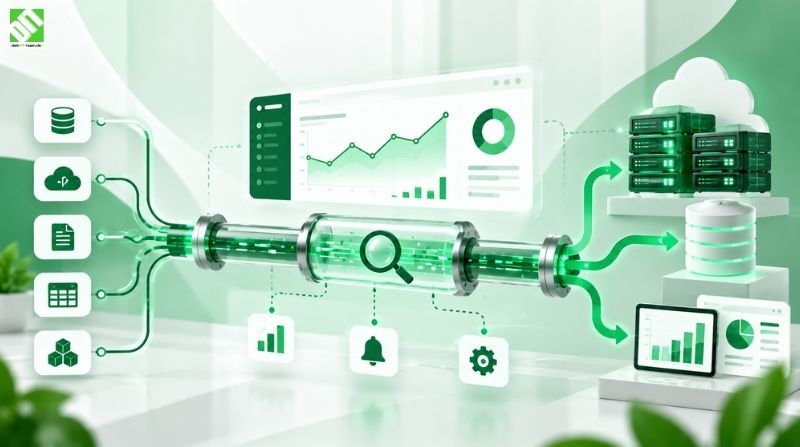
Learn what data pipeline monitoring is, why it matters, and how to implement it effectively for your data infrastructure.
Data moves through your organization constantly. Customer information flows into your systems. Transaction records accumulate in databases. Operational metrics stream from connected devices. But what happens when that movement stalls or breaks? Without visibility into your data pipelines, you might not realize your analytics are running on outdated information, your reports are incomplete, or your systems have silently failed until problems cascade into business impact.
Data pipeline monitoring is the practice of tracking data as it moves through extraction, transformation, and loading processes, catching issues before they affect decision-making or operations. For modern businesses relying on data-driven decisions, understanding your data pipelines and monitoring their health has become as essential as understanding your applications.
This guide explains what data pipeline monitoring actually is, why it matters, how it works, and what you need to implement it effectively.
What Is Data Pipeline Monitoring?
Data pipeline monitoring is the continuous observation of data workflows that move information from source systems to destinations. A data pipeline is essentially an automated process: data flows from one place (a database, application, or sensor), gets transformed or processed, and lands in a target system or data warehouse.
Think of it like a manufacturing assembly line. Products move through stages, get worked on, and arrive at the end. If a stage breaks down silently, you produce defective products without knowing. Data pipelines work similarly. When monitoring is absent, corrupted data, processing failures, or incomplete transfers happen without alerting anyone.
Data pipeline monitoring watches for problems at every stage: Are the source systems sending data? Is the transformation logic working correctly? Is data arriving at the destination on time? Are there any data quality issues? Monitoring answers these questions automatically and alerts teams when something goes wrong.
The alternative is discovering problems through customer complaints, inconsistent analytics, or business reports that don't reconcile with reality. By then, the damage is done. Monitoring prevents that scenario by catching issues early.
Why Data Pipeline Monitoring Matters
Modern organizations generate enormous amounts of data. A mid-size business might run dozens of pipelines simultaneously, moving millions of records daily. Without monitoring, you're essentially flying blind.
Data-driven decisions depend on accurate, timely information. If your analytics pipeline fails silently, decision-makers might act on outdated or incomplete data. Marketing teams might optimize campaigns based on incorrect metrics. Financial teams might misunderstand cash flow patterns. Operational decisions suffer when the data pipeline delivering information to dashboards breaks without anyone noticing.
Pipelines fail for many reasons: source systems go down, network connectivity issues occur, transformations encounter unexpected data formats, storage systems run out of space, or processing jobs timeout. Some failures are obvious. Others are subtle. Data might transfer partially. Processing might complete but produce incorrect results. Without monitoring, these silent failures propagate downstream.
Beyond accuracy, pipeline reliability affects business operations directly. E-commerce platforms need real-time inventory data flowing through pipelines. Healthcare systems need patient information pipelines functioning reliably. Financial institutions need transaction pipelines processing without interruption. When pipelines fail or slow down, operations suffer immediately.
The cost of pipeline failures varies, but generally increases with time undetected. An hour of a failed analytics pipeline might be irritating. A day might mean significant business decisions get made incorrectly. A week means structural problems in how the organization understands its own operations.
Monitoring transforms this from a crisis-response situation into a managed-risk situation. Teams know when problems occur, can prioritize fixes based on impact, and maintain accountability for data quality and availability.
Key Components of Data Pipeline Monitoring
Effective pipeline monitoring requires observing multiple dimensions of pipeline health.
Data volume monitoring tracks whether expected amounts of data are flowing through the pipeline. Unusual volume patterns often indicate problems before they become obvious failures. A sudden drop in data arriving at the destination suggests upstream issues. Unexpected volume spikes might indicate data duplication or processing loops.
Latency monitoring measures how long data takes to move from source to destination. For real-time analytics, minute delays matter. For batch processes, hour-long delays might be acceptable. Monitoring establishes baseline expectations and alerts teams when data processing slows unexpectedly.
Data quality monitoring validates that data arriving at destinations meets expected standards. This includes format validation (is data in the expected structure?), completeness checks (are all required fields present?), accuracy validation (do values fall within expected ranges?), and consistency checks (does data align with historical patterns?). Data can arrive on time and in full volume while still being corrupted or incorrect.
Error rate monitoring tracks whether processing jobs encounter failures. Some errors are recoverable. Others halt processing. Monitoring distinguishes between acceptable error rates (inherent to data processing) and problematic rates indicating systematic problems.
System health monitoring examines infrastructure supporting pipelines: CPU usage, memory consumption, storage capacity, network throughput. Infrastructure problems often manifest as pipeline problems. A full storage system halts data ingestion. CPU bottlenecks slow processing.
These dimensions work together. A pipeline might be delivering data on time (good latency), but data quality checks might reveal the information is corrupted. Volume might look correct, but latency monitoring shows processing taking three times longer than usual. Comprehensive monitoring observes all dimensions.
Common Data Pipeline Monitoring Challenges
Organizations implementing pipeline monitoring encounter predictable challenges.
Heterogeneous environments complicate monitoring. Modern data stacks mix on-premise databases, cloud storage, APIs, and specialized data warehouses. Different technologies have different logging standards, metrics formats, and monitoring interfaces. A unified monitoring solution needs to translate across this diversity.
Data quality complexity exceeds simple volume and latency checks. Real data is messy. Historical data might have quality issues. Transformations sometimes introduce subtle errors that don't cause outright failures but affect downstream analytics. Defining "good data" well enough to monitor automatically requires business domain expertise combined with technical understanding.
Alert fatigue undermines monitoring effectiveness. Too many alerts and teams stop paying attention. Too few and you miss problems. Tuning alert thresholds requires understanding baseline behavior, expected variability, and what actually matters. A spike in processing time for one pipeline might be normal, while the same spike for another might indicate problems.
Debugging pipeline failures is complex because problems can originate from multiple places: source data quality issues, transformation logic errors, infrastructure constraints, or destination system problems. Monitoring needs to provide enough diagnostic information to identify root cause quickly.
Integration with existing development and operations workflows matters practically. A monitoring system that produces useful alerts but doesn't integrate with incident management systems, ticketing systems, or communication tools gets ignored. Monitoring must fit into how teams actually work.
How Data Pipeline Monitoring Works Technically
At its core, data pipeline monitoring involves three components: collection, analysis, and alerting.
Collection gathers metrics and logs from pipelines. Different pipeline technologies expose different information. A cloud data warehouse provides metrics through APIs. A custom Python script writing to logs produces text output. ETL tools like Apache Airflow generate job execution records. Monitoring systems need to collect from diverse sources and normalize the data into a common format.
Analysis examines collected data to identify problems. Simple analysis watches for threshold violations: if latency exceeds the expected maximum, something is wrong. More sophisticated analysis looks for pattern deviations: if processing time varies more than historical norms, there might be capacity issues. Machine learning approaches learn normal behavior patterns and alert on anomalies.
Alerting notifies relevant teams when problems occur. Effective alerting is targeted: infrastructure teams get infrastructure alerts, data engineers get data quality alerts, analytics teams get latency alerts. Alerting should be actionable: not just "something failed," but "the morning ETL job encountered 250 null values in the customer_id field starting at 3:47 AM, causing 15-minute processing delay."
Different monitoring approaches exist. Application performance monitoring (APM) tools focus on application-level metrics. Infrastructure monitoring tools focus on servers, databases, and networks. Data pipeline-specific monitoring tools understand pipeline concepts like jobs, transformations, and data quality. Many organizations combine multiple approaches.
DevOps practices increasingly include pipeline monitoring as foundational infrastructure. Treating data pipelines with the same rigor as application deployment pipelines means monitoring, alerting, versioning, and testing infrastructure that mature operations teams already know.
Building a Data Pipeline Monitoring Strategy
Effective monitoring starts with clarity on what matters most to your business.
Identify critical pipelines first. Not all pipelines are equally important. The pipeline feeding your real-time analytics dashboard matters more than the pipeline archiving historical logs. The pipeline processing payment transactions matters more than the one updating non-critical reference data. Prioritize monitoring resources on pipelines with highest business impact.
Define SLAs (Service Level Agreements) for critical pipelines. How quickly should data arrive at destinations? What data quality standards must be met? What uptime is acceptable? These SLAs become the basis for monitoring thresholds. A pipeline guaranteed 99.9% uptime should alert differently than one with 95% uptime expectations.
Establish baseline behavior. Before alerting on anomalies, understand what normal looks like. This might mean running pipelines for weeks without alerts to establish typical latency, error rates, and volume patterns. Baseline data prevents false alarms from natural variability.
Select appropriate tools and technologies. Some organizations build custom monitoring on top of existing infrastructure monitoring tools. Others adopt pipeline-specific monitoring platforms. The right choice depends on existing technology investments, pipeline complexity, team expertise, and budget.
Integrate monitoring into incident response workflows. Monitoring is pointless if alerts go nowhere. Define who gets notified for different alert types, how quickly they should respond, what diagnostic steps they should take, and how to escalate if needed.
Technology Considerations for Data Pipeline Monitoring
Implementing pipeline monitoring requires understanding available technologies and approaches.
Cloud-native solutions leverage monitoring built into cloud platforms. AWS CloudWatch, Azure Monitor, and Google Cloud Logging provide pipeline visibility for workloads running on these platforms. These are often the simplest starting point if your infrastructure is cloud-based.
Open-source tools like Prometheus and Grafana provide flexible monitoring infrastructure. These require more configuration but offer maximum customization. Organizations with sophisticated monitoring needs often combine these with pipeline-specific solutions.
Custom software solutions purpose-built for your specific pipeline architecture might make sense for complex environments. These solutions integrate directly with your data stacks, understand your business context, and produce monitoring specifically relevant to your operations.
Data warehouse-native monitoring uses analytics capabilities within your data warehouse to monitor itself and connected systems. A data warehouse can run queries detecting data quality issues, analyze pipeline performance logs stored within itself, and generate alerts.
API-based monitoring connects to pipeline systems through their APIs, collecting metrics and logs without requiring direct access to infrastructure. This works well when pipelines run on managed services or SaaS platforms.
The right approach often combines multiple technologies rather than relying on a single tool.
Data Quality Monitoring in Detail
Data quality monitoring deserves special attention because it's simultaneously most complex and most valuable.
Schema validation ensures data matches expected structure. If a field that should contain numbers contains text, schema validation catches it. If required fields are missing, validation detects it. This is foundational: you can't process data reliably if it doesn't match expected structure.
Referential integrity checks verify that relationships between data are maintained. If a customer transaction references a customer ID that doesn't exist in the customer table, referential integrity checks flag it. These checks catch logical inconsistencies in data.
Range and format validation ensures values make sense. Temperatures outside physically possible ranges, dates in impossible formats, monetary amounts with invalid currency codes—validation catches impossible values.
Uniqueness and deduplication checks prevent duplicate data. Some pipelines should produce unique records. Duplicates indicate processing errors or data corruption.
Statistical profiling monitors data characteristics. If email addresses are usually lowercase but suddenly 20% are mixed case, profiling detects unusual patterns. If numeric fields average consistent values but suddenly the average doubles, something changed.
Completeness monitoring tracks whether pipelines deliver expected data. Are expected records arriving? Are counts matching expectations? Are any fields systematically null?
These quality checks require understanding what "good data" means for your business. That understanding often comes from data engineers who've worked with the data, business analysts who understand data semantics, and experience detecting past data issues.
Common Data Pipeline Monitoring Use Cases
Different organizations use pipeline monitoring differently based on their data maturity and business needs.
Analytics pipeline monitoring ensures business intelligence systems receive accurate, timely data. Marketing teams need traffic data flowing reliably into analytics platforms. Finance teams need transaction data processed daily. When analytics pipelines fail, decision-making suffers immediately.
Real-time operational pipelines require different monitoring than batch analytics. A real-time inventory pipeline for e-commerce needs second-level visibility into performance. Small delays cascade into customer-facing problems. Latency monitoring becomes critical.
Data warehouse monitoring ensures the central data repository receives data reliably and maintains quality. The data warehouse is often the source of truth for analytics, so its reliability directly impacts organizational confidence in data.
Machine learning pipeline monitoring ensures training data flows reliably to model development systems and model predictions flow reliably to applications. ML pipelines are particularly sensitive to data quality issues because bad training data produces bad models silently.
Compliance and audit pipelines need monitoring ensuring data required for regulatory reporting flows correctly and gets transformed according to rules.
Implementing Pipeline Monitoring: Practical Steps
Organizations typically implement monitoring gradually rather than attempting comprehensive monitoring immediately.
Start small with critical pipelines. Choose one or two pipelines with highest business impact and implement monitoring there first. This allows learning what monitoring actually requires before expanding.
Use existing monitoring infrastructure where possible. If you already have infrastructure monitoring tools, start there. Add specialized monitoring incrementally.
Define baseline expectations before enabling alerts. Run monitoring quietly for several weeks, gathering baseline data on normal behavior before turning on alerts.
Start with simple monitoring then add sophistication. Simple latency and volume monitoring might catch 80% of problems. Add data quality checks after basic monitoring stabilizes.
Integrate monitoring into incident response. Make sure monitoring actually changes how teams respond to problems. If monitoring exists but isn't connected to incident workflows, teams won't benefit from it.
Invest in team knowledge. Monitoring systems don't run themselves. Someone needs to understand what different metrics mean, how to tune alerts, and how to use monitoring data to improve pipelines.
Conclusion
Data pipeline monitoring transforms how organizations manage data infrastructure. Without monitoring, pipeline failures remain invisible until they damage business decisions or operations. With monitoring, problems get detected quickly, allowing rapid response.
Implementing effective monitoring requires understanding what you're monitoring, why different metrics matter, and how to turn monitoring data into action. It's not just technology selection but also organizational practice: defining SLAs, establishing baselines, and integrating monitoring into incident response workflows.
The good news is that monitoring doesn't require perfection. Starting with simple monitoring of critical pipelines often catches most problems. As monitoring matures, organizations add sophistication—quality checks, ML-based anomaly detection, and deeper diagnostic capabilities.
If your organization is building or expanding data infrastructure, treating pipeline monitoring as a foundational component rather than an afterthought prevents the costly discovery of failures through business impact.
Building or improving data pipeline monitoring often involves understanding existing technology stacks, integrating monitoring across diverse platforms, and potentially building custom solutions aligned with specific business needs. These are exactly the challenges that technical teams handle, and they're also the challenges where expertise in cloud integration and data infrastructure pays dividends. If you're evaluating how to approach pipeline monitoring in your organization or need guidance on building monitoring for complex data environments, discussing your specific situation helps clarify what monitoring approach makes sense for your business.
Frequently Asked Questions
What's the difference between data pipeline monitoring and infrastructure monitoring?
Infrastructure monitoring watches servers, databases, and networks. Data pipeline monitoring watches data itself: whether it's flowing, arriving on time, and maintaining quality. You need both. Infrastructure problems cause pipeline failures, but infrastructure looking healthy doesn't guarantee data quality or on-time delivery.
How do you monitor data quality automatically?
Data quality monitoring uses rules that check data against expectations: does it match expected format, contain required fields, fall within valid ranges, match historical patterns? These rules run automatically on incoming data and alert when violations occur.
What's an acceptable latency for data pipelines?
That depends entirely on your use case. Real-time operational systems might require minute-level or second-level latency. Analytics systems might accept hour-level latency. Batch processing systems might run once daily. Define SLAs based on how you actually use the data.
Can you monitor pipelines built with different technologies together?
Yes, but it requires a monitoring approach that works across your technology stack. Cloud monitoring tools work well for cloud-based pipelines. Open-source tools like Prometheus offer flexibility across diverse technologies. Sometimes this means combining multiple monitoring solutions.
What should you do when pipeline monitoring detects a problem?
Have a process defined beforehand: who gets notified, how quickly should they respond, what diagnostic steps should they take, and how do they escalate if needed. Monitoring is only valuable if it connects to response processes.
How do you tune pipeline monitoring alerts to avoid false alarms?
Build a baseline of normal behavior before enabling production alerts. Understand natural variability in your pipelines. Set alert thresholds based on what actually indicates problems rather than minor deviations from averages. Iterate on thresholds based on false alarm patterns.
Should you build monitoring in-house or use existing tools?
Both have validity. Off-the-shelf tools require less development but might not perfectly fit your environment. Custom monitoring understands your specific pipelines but requires more maintenance. Many organizations start with existing tools then build custom solutions for specific needs.
How does pipeline monitoring relate to data governance?
Pipeline monitoring ensures data meets quality standards defined by governance policies. Governance defines "what quality means," monitoring ensures data actually meets those standards. They're complementary: governance without monitoring is aspirational; monitoring without governance lacks direction.
What's the cost of implementing pipeline monitoring?
It depends on your data complexity and tool choices. Cloud-native monitoring might cost hundreds monthly. Enterprise monitoring platforms might cost thousands monthly. Custom-built solutions involve engineering time. The real question is cost compared to the cost of undetected pipeline failures.
How does CI/CD connect to data pipeline monitoring?
Continuous integration and deployment for data pipelines means treating pipeline code like application code: version controlled, tested, and deployed through automated processes. Pipeline monitoring becomes part of the CI/CD process, ensuring deployed pipelines work correctly in production.
Recent Posts
September 24, 2026


September 25, 2026

September 16, 2026