Mobile App Development Process: A Step-by-Step Guide for Businesses in 2026
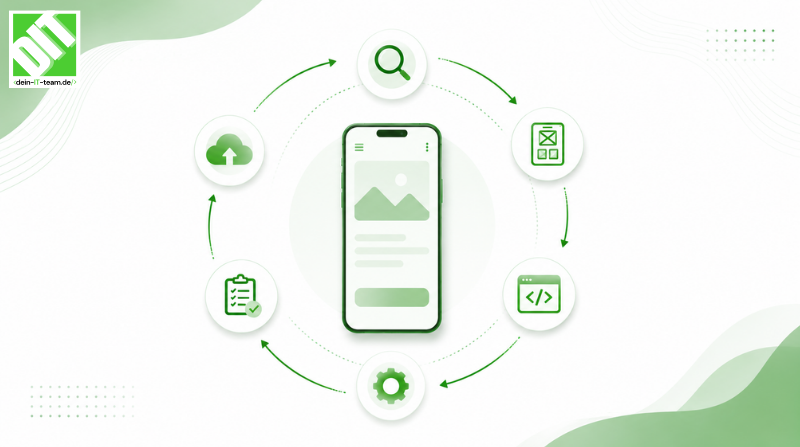
Step-by-step guide to the mobile app development process in 2026. Learn how to plan, build, and launch successful apps.
Building a mobile application in 2026 is no longer just about writing code for an iPhone or Android screen. Mobile technology has evolved into a hyper-connected ecosystem driven by cloud infrastructure, API-first architecture, cross-platform framework efficiencies, and high user expectations for speed and security.
For business leaders, product managers, and founders, launching a digital product requires a structured execution plan. Jumping straight into coding without proper discovery or system architecture leads to misaligned expectations, budget overruns, and high user churn.
This guide breaks down the full mobile app development process into logical, executable stages so your enterprise can move efficiently from initial concept to a scalable release.
Key Takeaways
Discovery Prevents Budget Waste: Validating product scope and establishing a Minimum Viable Product (MVP) upfront eliminates unnecessary engineering costs.
Architecture Dictates Scalability: Selecting the right technology stack (native vs. cross-platform) directly impacts launch speed, performance, and long-term maintenance overhead.
Design Drives Retention: UI/UX design must focus on minimizing friction, lowering cognitive load, and maintaining accessible design patterns across screen sizes.
Quality Assurance Starts Early: Continuous testing across functional, security, and performance vectors drastically reduces post-launch bug fixes.
Launch is the Baseline, Not the End: Post-launch success depends on active app store optimization, infrastructure monitoring, and continuous iterative updates.
Stage 1: Product Discovery, Scope Definition, and Strategy
Every successful software project starts long before the first line of code is written. Strategic discovery aligns your business objectives with actual target market demands.
Market Research and User Intent Analysis
Before committing capital, analyze competitor gaps and user friction points within your industry. Collect data on user behavior, evaluate existing category offerings, and document target personas. Understanding what users dislike about existing market alternatives gives your product a distinct competitive edge.
Scope Definition and Feature Prioritization
Attempting to build every feature at once leads to scope creep. Divide your feature roadmap into essential core features and future enhancements. Focus your initial release on solving one primary business problem exceptionally well. This lean approach reduces initial time-to-market and keeps capital free for post-launch iteration.
Strategic Monetization and KPI Setup
Define how the application drives business value—whether through direct subscriptions, in-app purchases, transaction fees, or operational cost reduction. Establish measurable key performance indicators (KPIs) early on, such as Day-30 user retention, average session length, and customer acquisition cost (CAC).
Stage 2: Technical Architecture and Platform Selection
Choosing how your software is structured and hosted dictates how easily your app scales as your active user base grows.
Native vs. Cross-Platform Frameworks
Your target platform determines your engineering approach:
Native Development using Swift or Kotlin delivers maximum hardware performance, deep OS access, and smooth frame rates. This approach is ideal for heavy graphic processing or hardware-intensive utility apps.
Cross-Platform Development using Flutter or React Native shares a single codebase across iOS and Android, cutting initial build time and operational expenses while retaining near-native performance for most enterprise applications.
Cloud Backend and Database Infrastructure
A mobile app's front end relies heavily on server-side health. Modern mobile solutions require scalable cloud architectures, reliable database management, microservices, and secure authentication pipelines. Integrating professional mobile app development services ensures your backend infrastructure dynamically scales under sudden traffic spikes.
Designing Secure API Contracts
Your mobile app front end communicates with back-end databases and external services through application programming interfaces (APIs). Designing clear API contracts early allows front-end and back-end engineering teams to build simultaneously without blocking each other's progress.
Stage 3: UI/UX Design and Prototyping
User retention relies heavily on visual clarity and interface simplicity. If an app is confusing or slow to navigate, users delete it within minutes.
UX Wireframing and User Flow Mapping
User experience (UX) design focuses on structural layout rather than visual decoration. Designers create wireframes—simple structural blueprints—to map out navigation pathways. Mapping every user journey ensures key actions, like registering or completing a purchase, take as few taps as possible.
UI Design Systems and Branding
User interface (UI) design adds visual personality. Establishing a comprehensive design system—with reusable color tokens, typography scales, button states, and spacing grids—ensures visual consistency across dozens of screens. A unified design system also accelerates front-end development speed.
Interactive Prototyping and Usability Testing
Before writing front-end code, clickable prototypes built in design tools like Figma are placed in front of real test users. Identifying navigation confusion or layout issues during design costs a fraction of refactoring functional application code later in production.
Stage 4: App Development and Systems Integration
This is the central execution phase where design assets, backend databases, and user interface components come together into a functional product.
Front-End Engineering
Front-end developers translate visual UI designs into dynamic, interactive screen layouts. They handle local data storage, client-side caching, screen transitions, state management, and user input validation.
Back-End and API Integration
The back-end layer processes business logic, handles server storage, executes secure payment processing, and sends push notifications. Custom backend systems often require specialized third-party software connections or custom data pipelines. Building robust custom solutions or implementing custom API development guarantees secure, high-speed data delivery between internal business platforms and mobile devices.
Third-Party Software and Enterprise Tooling
Modern applications rarely exist in isolation. They connect to external analytics tools, customer relationship platforms, payment gateways, and authentication providers. When enterprise companies need unified software across desktop and mobile operations, leveraging specialized Microsoft application development services allows internal databases and employee workflows to sync securely with customer-facing mobile applications.
Stage 5: Quality Assurance and Security Hardening
Rigorous quality assurance (QA) ensures your application runs smoothly across hundreds of distinct screen dimensions, hardware configurations, and network conditions.
Types of Essential Testing
Functional Testing verifies that every feature, flow, button, and submission form acts exactly as intended.
Performance and Load Testing tests how the application behaves under high user volume, poor cellular network connections, or low battery conditions.
Security and Compliance Audits scan for API vulnerabilities, enforce data encryption standards, and verify compliance with regional privacy laws like GDPR and CCPA.
Device Compatibility Testing ensures layout integrity across various iOS and Android screen resolutions, aspect ratios, and operating system versions.
Stage 6: Deployment and App Store Optimization (ASO)
Releasing software to the public requires adhering to strict store submission guidelines established by Apple and Google.
App Store Listing Preparation
To maximize discoverability, your marketing and technical teams must collaborate on store listing metadata. This includes writing keyword-optimized titles and descriptions, preparing high-resolution preview screenshots, and publishing a clear privacy policy URL.
Submission and Review Workflow
Both the Apple App Store and Google Play Store review every submission for security risks, content violations, and crash bugs. Following platform design standards and setting up proper test credentials for review teams minimizes rejection delays.
Modern Application Planning Considerations
A common issue businesses face during software development is feature creep—adding so many secondary features that launch deadlines slip and development budgets stretch thin.
During early scoping, keeping your development timeline focused on a streamlined Minimum Viable Product (MVP) protects your capital. Ensuring your roadmap prioritizes the Top Features Every Business Mobile App Must Have in 2026 allows your team to launch a high-impact core product, validate user demand, and expand functionality through data-backed updates.
Stage 7: Post-Launch Support, Analytics, and Iteration
Publishing your application is not the end of the software lifecycle—it is the baseline for ongoing growth.
Infrastructure and Crash Monitoring
Post-launch telemetry tools track system crashes, API response latencies, and unexpected errors in real time. Fast response times to unexpected bugs build long-term user trust and protect store review ratings.
User Feedback and Feature Iteration
Analyze user interaction heatmaps, store reviews, and in-app feedback channels. Use this empirical data to schedule regular sprint releases that refine existing flows, introduce highly requested secondary features, and keep pace with annual OS updates.
Conclusion
Navigating the mobile app development process successfully requires balancing business strategy, human-centered UI/UX design, engineering rigor, and proactive quality assurance. Skipping planning phases or rushing through API security checks almost always leads to costly redesigns later on.
By following a structured execution roadmap—defining your scope, building a resilient cloud backend, prioritizing core features, and continually acting on real-world user data—your organization can deliver a scalable, enterprise-grade mobile product that drives tangible business value.
Frequently Asked Questions (FAQs)
What is the typical timeline for the mobile app development process?
A simple application with core utility features takes roughly 2 to 3 months. Medium-complexity business applications generally require 4 to 6 months, while enterprise-grade applications with custom backend integrations and complex workflows take 6 to 10+ months.
Should I build a native app or a cross-platform app for my business?
If your application requires heavy graphic processing or deep hardware interaction, native development (Swift/Kotlin) is ideal. However, for most business tools, e-commerce applications, and service platforms, cross-platform frameworks like Flutter offer comparable performance while reducing build times and maintenance costs.
How do I prevent budget overruns during software development?
Budget overruns are usually caused by changing project requirements midway through development. Conduct thorough product discovery upfront, create an explicit specification document, launch with a lean Minimum Viable Product (MVP), and use agile sprints to manage feature additions in planned phases.
Recent Posts
October 16, 2026
October 15, 2026