How Cross-Platform Mobile App Development Cuts Launch Costs in Half

Slash mobile development costs. Learn how cross-platform frameworks eliminate codebase duplication and speed up app store launches.
How Cross-Platform Mobile App Development Cuts Launch Costs in Half
Launching a mobile application to capture market share often forces scaling businesses into an expensive strategic trap: building two completely separate software products simultaneously. Engineering a native iOS app in Swift alongside a native Android app in Kotlin duplicates your development headcount, fragments project management timelines, and isolates your software QA pipelines. For fast-growing enterprises, this traditional approach drains vital capital before the product even establishes a market foothold.
To overcome this financial bottleneck, tech leaders are transitioning away from dual native pipelines and moving toward unified software strategies. Aligning engineering efforts under a single shared codebase allows companies to launch highly responsive, feature-rich mobile applications to both major app stores at a fraction of the cost. Partnering with seasoned teams for professional c guarantees that your cross-platform digital architecture delivers an uncompromised native feel while maximizing corporate resource efficiency.
Key Takeaways
Maintaining two separate native codebases duplicates developer payroll and isolates product release schedules.
Cross-platform frameworks utilize a single unified codebase to deploy highly reactive software onto both iOS and Android.
Eliminating duplicate feature engineering cycles slashes product time-to-market and cuts initial launch expenses in half.
Centralized QA pipelines allow engineers to write code updates and bug fixes once, deploying them universally.
Modern hybrid app architectures ensure smooth device-level sensor and API connections without sacrificing interface speeds.
The Hidden Overhead of Traditional Native Codebases
Operating a multi-platform digital business through native deployment pipelines introduces substantial hidden friction to your product team. Because Swift and Kotlin are fundamentally distinct languages, a feature optimization or interface adjustment built for iOS cannot simply be pasted into your Android repository. Your team is forced to pay separate engineering squads to solve the exact same logic problems, build the exact same UI layouts, and map the exact same database requests twice.
This engineering fragmentation creates massive organizational strain. Project management teams struggle to keep feature lists aligned, product rollouts fall out of sync, and core engineering hours are wasted on duplicate tasks. Ensuring your mobile architecture connects smoothly to backend layers through tailored custom software development practices prevents your enterprise from accumulating massive, structural technical debt across disconnected client repositories.
Maximizing Resource Efficiency with a Single Shared Codebase
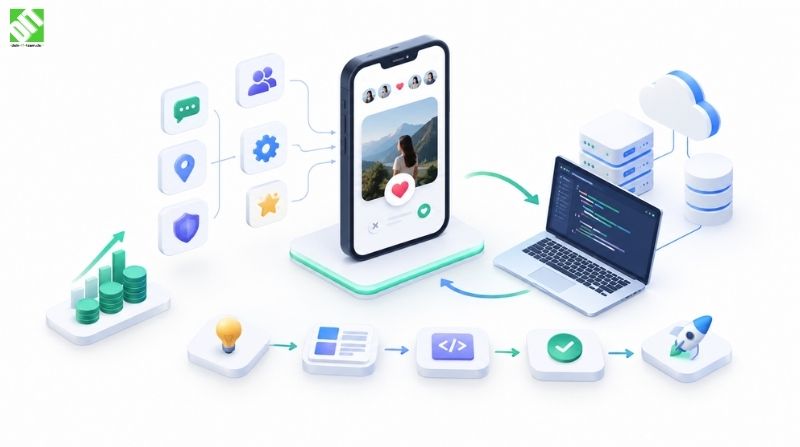
Cross-platform development frameworks eliminate this duplicated labor by allowing engineers to write a unified code layer that compiles into native UI components on both operating systems. By shifting the deployment blueprint to a single, high-performance repository, your enterprise can reallocate development assets strategically—focusing engineering capital on core features, security hardening, and refining user journeys.
This structural alignment directly impacts long-term maintenance dynamics. When your app relies on one master code engine, deploying critical product updates or security patches happens simultaneously across all devices. This unified ecosystem significantly reduces post-launch engineering upkeep. To keep these dynamic client environments fully optimized, tech organizations rely on robust cloud integration services to guarantee that instant cross-platform data transactions remain stable, secure, and responsive under scaling user loads.
Driving Product Agility with Unified QA and DevOps Automation
In software engineering, speed is a core competitive advantage. A prolonged development cycle doesn't just increase engineering payroll; it risks allowing competitors to capture target user segments first. Native development environments lengthen timelines because quality assurance teams must manually validate, track, and debug two distinct codebases across multiple device testing matrices.
Cross-platform frameworks dramatically compress this verification phase by enabling shared testing scripts and centralized deployment monitoring. Testing a core business transaction loop once validates the feature for your entire mobile infrastructure. Integrating professional hands-on DevOps services allows enterprises to anchor their single-codebase repositories into automated CI/CD engines. This combination lets your squad ship platform updates, clear bugs, and roll out feature upgrades continuously without introducing operational bottlenecks.
Overcoming Legacy Performance Concerns on Modern Architectures
A common historical reservation among product stakeholders is the worry that cross-platform frameworks sacrifice processing speed, screen transition fluidity, or deep system tool accessibility. While early generation hybrid web wrappers occasionally suffered from interface lag, modern cross-platform engines communicate directly with underlying device layers through hardware-accelerated bridges.
Today's unified applications render interfaces at a fluid 60-to-120 frames per second, matching the touch responsiveness of native designs. They also support complete, secure access to native device features like biometric sensors, camera arrays, location tracking, and local storage. Tech leaders can verify this structural evolution by looking at comprehensive system case studies; reading through why API-first development is essential for digital transformation outlines how decoupled backend microservices empower cross-platform apps to execute complex computations instantly without draining local device memory.
Conclusion
Opting for cross-platform mobile development is a highly tactical financial and engineering decision for scaling brands. By treating client-side applications as a unified product engine rather than two separate native projects, tech leaders eliminate duplicate development overhead, reduce launch timelines, and simplify long-term software maintenance. This streamlined approach allows fast-moving organizations to protect initial cash flow, accelerate product-market fit, and establish a high-performance digital presence capable of scaling efficiently alongside customer demand.
Frequently Asked Questions
What are the primary cross-platform frameworks used to build business applications? The industry standard frameworks for enterprise-grade cross-platform development are Flutter (engineered by Google) and React Native (engineered by Meta). Both options allow developers to write code inside a single repository and deploy highly responsive, visually indistinguishable apps onto both iOS and Android.
Will using a cross-platform approach impact the app store approval process? No. Applications built using modern cross-platform frameworks compile into standard binary files that comply with all layout guidelines and security protocols required by both the Apple App Store and the Google Play Store.
Can an existing native app be converted into a cross-platform codebase? Yes. While it requires migrating the client-side UI and logic layers into a shared framework, your backend services, database structures, and external API integrations can remain completely untouched, ensuring minimal disruption to active users during the structural transition.